Worth the Gamble
Defensive Tactics Film + Data

I want to give my attention toward the defense after a heavy focus on the offense for much of the season. New York's defense took a leap this season, finishing the regular season with the 2nd-best defensive rating since January 20th (108.2) before storming into the playoffs and ranking as the number-one defense in the playoff field at a 104.5 defensive rating. Last postseason, with essentially the same roster, the Knicks posted a 113.2 defensive rating and drew heavy criticism toward the Jalen Brunson-Karl-Anthony Towns duo. A change that dramatic points to real structural changes, some of which we'll cover here.
Coverage Change
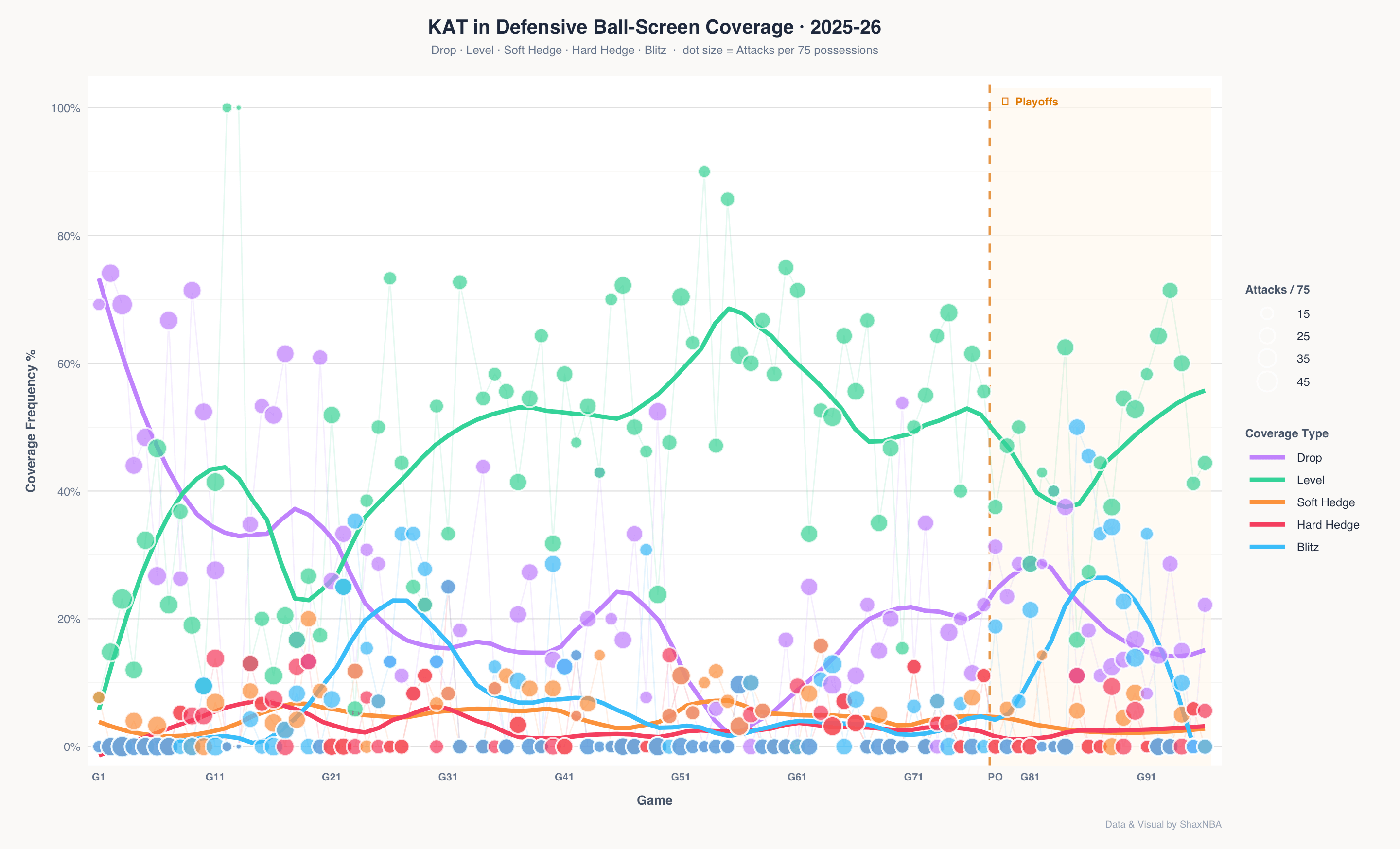
Mike Brown’s Knicks leaned heavily on higher coverages throughout the season rather than playing drop for most of the year. That started with getting level at the screen, specifically for Karl-Anthony Towns, who has spoken positively about this coverage, citing his ability to use his “god-given traits” (length, height and size) more effectively.
"The times we can use our God-given traits and our height...that's when it can get really good for us"
- Towns on defending the pick-and-roll more aggressively
Worth noting, this quote comes from the 2024-2025 season, when Towns saw a lower usage in aggressive coverages. So why does this matter, and why did Brown consider it as their best approach?
Towns doesn’t protect the basket well, and that may be an understatement. He ranks among the worst bigs at rim protection, posting a -2.8% Rim FG% Differential in the 36th percentile at his position. He falters at squaring up incoming drivers, defending without fouling, and lacks technique in deep drop coverage, particularly retreating and guarding two players simultaneously.


Brown’s scheme reflects a clear awareness of those limitations, keeping Towns out of deep drop coverage situations where he’d need to guard both the handler and the roll man while protecting the rim. Instead, it keeps him engaged and accountable in coverage with a defined responsibility. I’d like to believe that playing level for much of the season improved his defensive acumen and overall focus on that end. Towns also deserves credit for embracing that role, defending the way he did this season while sacrificing touches to lean into the dirty work.
The regular season sharpened the knife for the playoffs, and no example illustrates that better than Game 2 against the Sixers, where lead handler Tyrese Maxey faced 20 aggressive coverages(!!). Playing this way throughout the season gave the rotation, the feel and communication necessary to execute high coverages more consistently. Across multiple series, teams need to oscillate between different coverages, sometimes within the same series, and New York’s preparation for that kind of shapeshifting showed. In the clip, Josh Hart serves as the tagger in the low man role, Miles McBride zones up both weak-side shooters, and Hart recovers back out. A reminder that the coverage doesn’t hinge on Towns, the screener’s defender, or the point-of-attack man, the helping backline does the heavy lifting. When you have a collection of talented defenders in Anunoby, Hart, Bridges, Alvarado, McBride, and Shamet, they make that job easier.
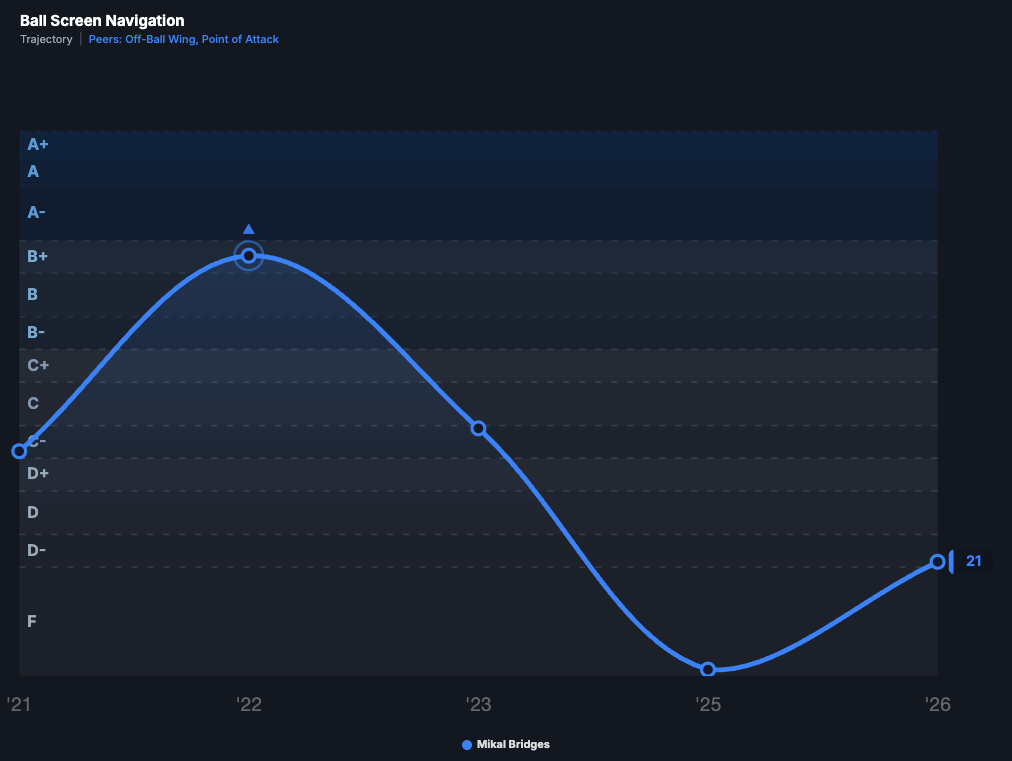
We’ve discussed Towns as the screener, but Mikal Bridges also benefits heavily from this coverage as a screen navigator. Since arriving in New York, he’s ranked poorly in that aspect while showing a much stronger aptitude off the ball. This coverage doesn’t just reduce his screen navigation burden, it places him in the optimal environment to thrive as a heavy rotation, chaos agent.
Mikal Bridges Defensive Playmaking Percentiles by Position:
2024-2025 → 2025-2026
18th percentile in STLs per 100 → 70th percentile
51st percentile in BLKs per 100 → 89th percentile
Stop% (stops per 100 = steals + offensive fouls drawn + recovered blocks):
27th percentile → 80th percentile
16th percentile in Forced Turnovers per 100 → 69th percentile
14th percentile in Deflections per 100 → 53rd percentile
I’m not directly correlating the change in coverage to Bridges’ defensive playmaking rise, but the opportunity certainly increased, whether in a tagger role or zoning up.
The Gamble
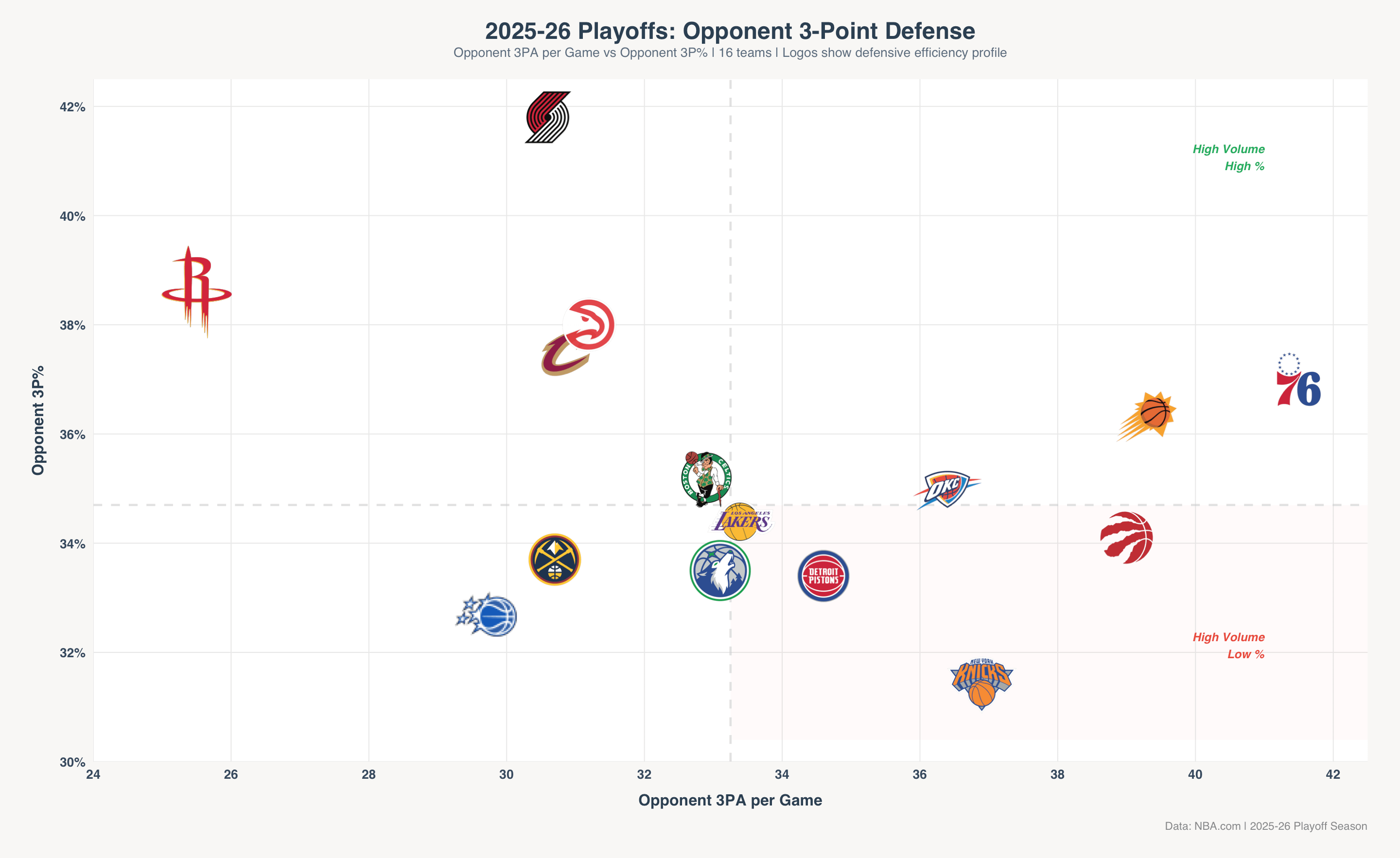
Level/high coverage on ball-screens carries real risk, it invites open threes, and puts the defense at the mercy of who's shooting well that night. The Knicks caught some breaks this postseason; opponents simply missed shots they'd normally make. But luck doesn't tell the whole story. New York scouted and adjusted throughout multiple series, funneling drives toward weaker shooters and tightening up on the ones who could punish them. The mix of variance and strategy defined their defensive turnaround.
Game 4 against San Antonio put the danger of variance on full display: the Spurs caught fire from three early, capitalizing on aggressive tagging. Arguably, the Spurs stand as the greatest "final boss" you could've pictured for the Knicks when it came to this coverage. They present a unique challenge in Victor Wembanyama as a massive gravitational roller who commands enormous amounts of attention, but the same principle applies. Stop his roll, and you can hand San Antonio multiple open three-point looks in return.
The Knicks stifled the Spurs’ offense by keeping their big attached to Wembanyama as tightly as possible while limiting the tag, whether that meant gapping up on the handler or going under more ball-screens as the series progressed.
Aggressive coverage paid its biggest dividends against the Atlanta Hawks, while moving Brunson off CJ McCollum to guard Dyson Daniels, and getting rid of the cross-match. New York decided to sell out on Atlanta’s best shooters and funnel the ball toward their worst ones.
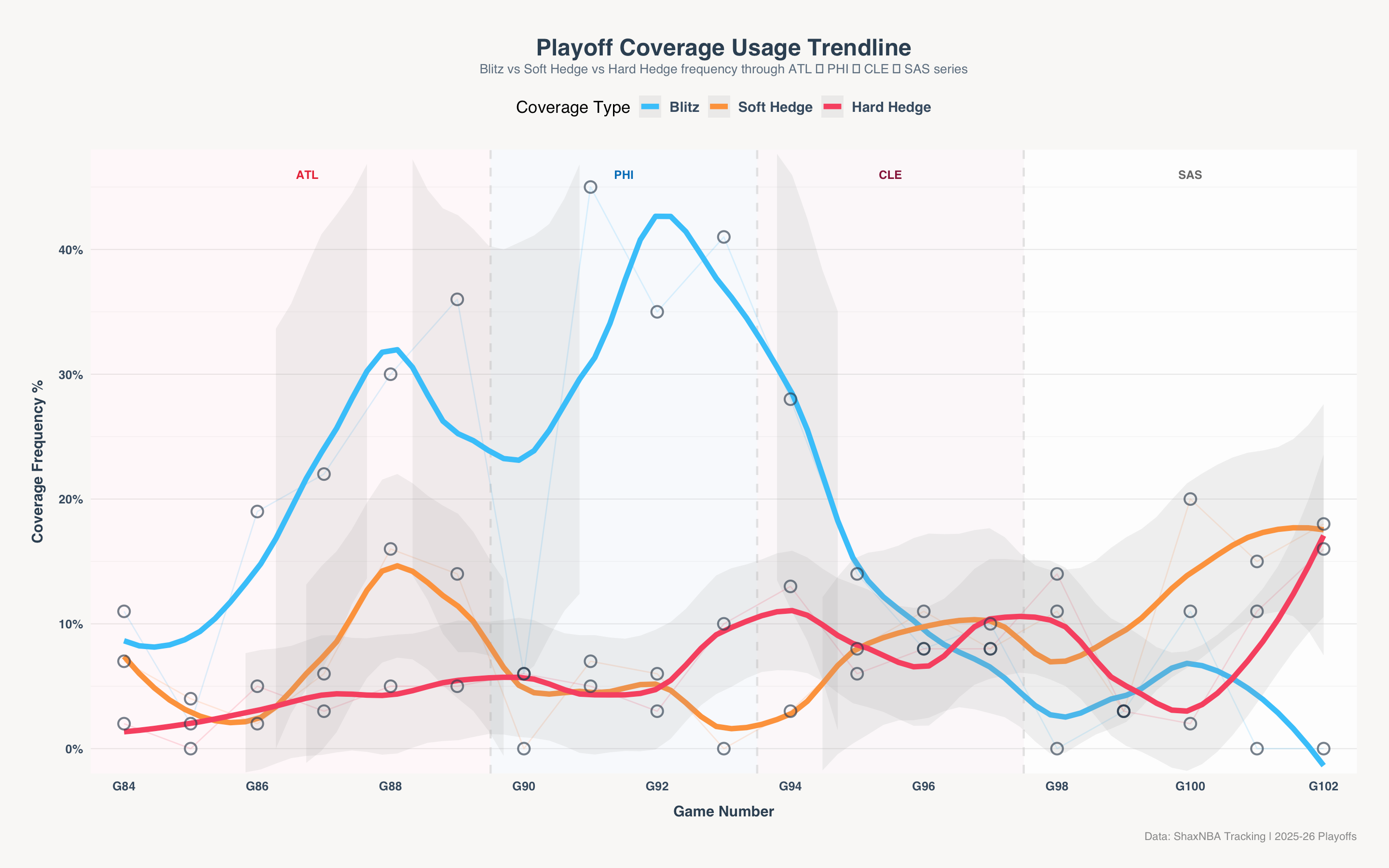
Notice the rise in aggressive coverage usage as the Atlanta series went on, it became a sure-fire way to dictate Atlanta's offense and exposed their most fatal flaw: not enough reliable perimeter threats in the rotation. That coverage tones down against Cleveland, where the Knicks face a more dangerous playmaker in James Harden. They blitzed 25 times across the first two games, surrendering 1.20 points per action, a really poor number. They opt to play more level, pulling back on forcing advantage basketball and relying on their point-attack defense with occasional tag responsibility.
Playing high on ball-handlers like Harden and Donovan Mitchell remains necessary to take away pull-up opportunities and walks into the lane. One idea I saw floated, and considered myself, was matching Towns on Mobley instead of Allen. That removes Harden’s favorite screener and turns Mobley into a pop big rather than a roller or spacer. With Allen sitting in the dunker, the Knicks can hedge or play level and defend the back end with far less complexity.
Mobley's lack of shooting touch and outside range severely hindered Cleveland's offense. Across the four games he attempted 21 threes, making just 6, rarely punishing New York's high coverage on ball-screens. Much like the Atlanta series, that kind of shooting performance and play-style gives aggressive coverages room to breathe. Nearly every Cleveland lineup combination struggled in this series, but the Mobley and Allen pairing yielded a -27 net rating, the lowest of any two-man combo logging more than 50 minutes together.
A key component paired with this defensive coverage has been their icing of ball-screens, implemented in late January. It assists Bridges as a screen navigator, directing the handler straight into the coverage with multiple help defenders ready to tag on a pop or roll. I broke this coverage down in more depth in a separate piece:

Conclusion
Brown’s tactical shift strengthened New York’s personnel in the long run, building their ability to handle different situations come playoff time while reinforcing defensive cohesion. Even watching them surrender open catch-and-shoot threes to the Washington Wizards or Brooklyn Nets throughout the season, the frustration fades once you recognize what they were aiming towards.
The physical toll this coverage demands also seemed largely absent, the Knicks earned extended rest through their own dominance, including a couple of sweeps, while logging fewer minutes per game from key defenders like Bridges, Hart, and Anunoby compared to the 2024-2025 run. Few teams at this stage of a championship run enter each series as fresh as New York did, contributing to them capturing the ultimate prize.
built different
excellent breakdown