Making Adjustments
What's changed defensively?

The Knicks’ defense is back, and you could argue it’s never been better. With that in mind, now feels like the ideal time to dig into the pick-and-roll data to see whether any meaningful changes have emerged. Opponent quality does matter, and the most recent stretch has featured some lower-end offenses, but there are still valuable takeaways to be found.
Ice the Ball-screen (push sideline)
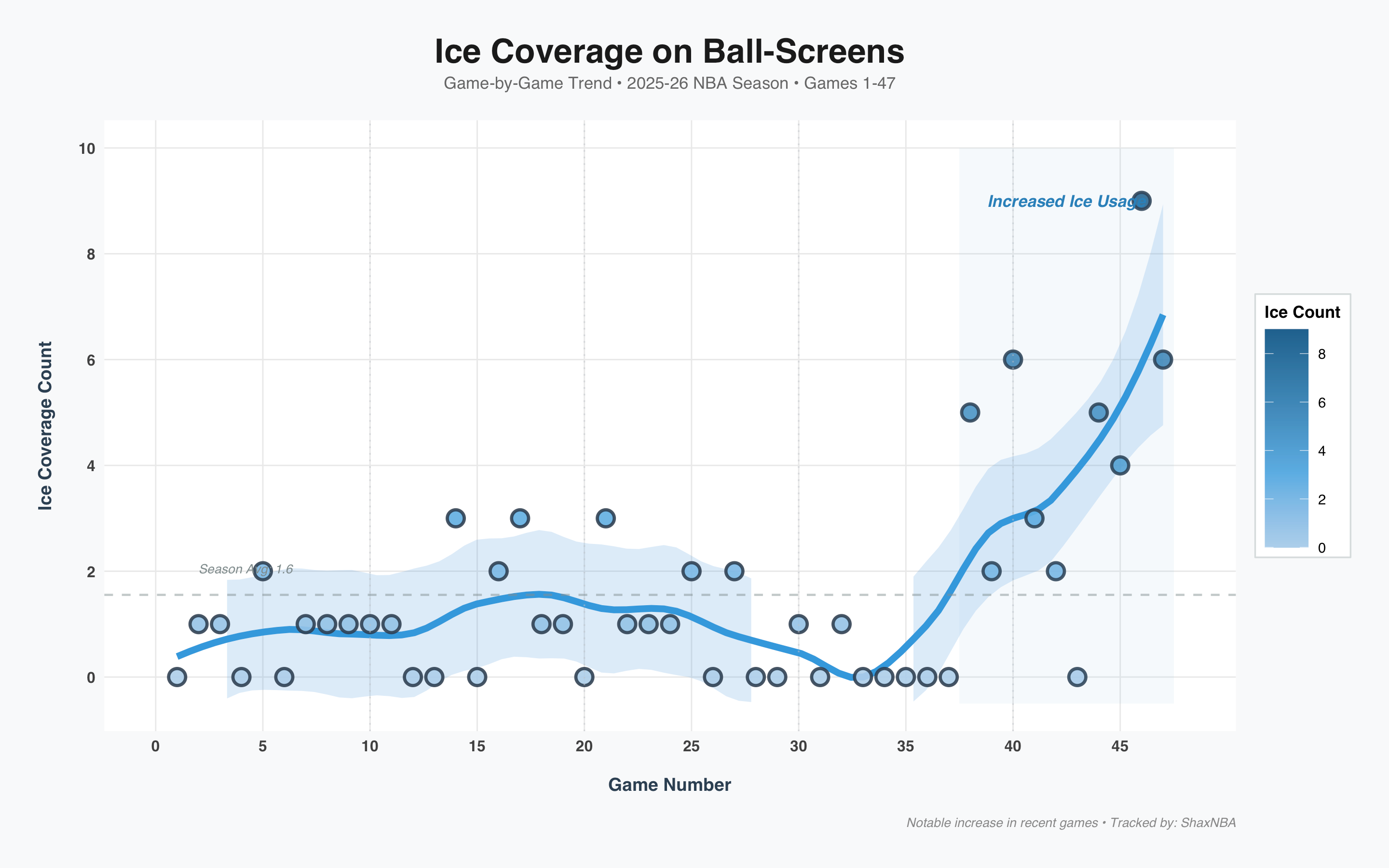
Recently, the Knicks have placed a greater emphasis on pushing ball-handlers toward the sideline, and it’s paying off. This is an area where they were inconsistent not too long ago. Coincidentally, it’s also a staple of Tom Thibodeau’s defensive philosophy, one he made infamous during his coaching career. Icing a ball screen isn’t just about what the point-of-attack defender is doing; it also requires the screener’s defender to be in the right position, making communication critical:
Notice how Bridges sets up at the point of attack. He’s into the basketball and turns his hips to guide DeMar DeRozan toward the sideline. The screener’s defender, Mitchell Robinson, can play any coverage, as long as he’s positioned on the correct side. Instead of sitting in the middle of the floor, Robinson is already waiting on the side Bridges is steering DeRozan toward.
Why does this work? One core principle defenses can operate from is a “no middle” philosophy, forcing ball-handlers and help toward the sideline. When a handler gets downhill through the middle, he naturally has more options depending on the coverage. By preventing DeRozan from turning the corner in the middle of the floor, the Knicks also create a numbers advantage. Josh Hart and Miles McBride are both able to slide into help positions, which is how McBride ultimately forces the turnover. If Sabonis were rolling toward Karl-Anthony Towns instead, KAT would be the lone helper. So there’s varying degrees of “why” to use the coverage.
Just as described, Bridges signals KAT to shift his coverage toward the sideline as he prepares to ice the ball screen. Look at the amount of help Sabonis runs into, Hart is there, Brunson is there, and OG is positioned as the low man. That help density makes it easy to tag the roller and still recover. In this case, it allows KAT to get back to Sabonis, and ultimately force a miss.
Not only are the Knicks using this coverage more frequently, it’s also been highly effective. Against Philadelphia, opponents scored just 0.44 points per action across nine possessions. Sacramento managed 0.33 PPA in six plays, Portland 0.40 PPA in six plays, and the Clippers 0.71 PPA in five plays. These are elite and telling numbers.
Obviously, this isn’t a coverage they can deploy every time, pick-and-rolls don’t always originate near the sideline, but it’s something worth watching and tracking.
Share the Wealth at the Point of Attack
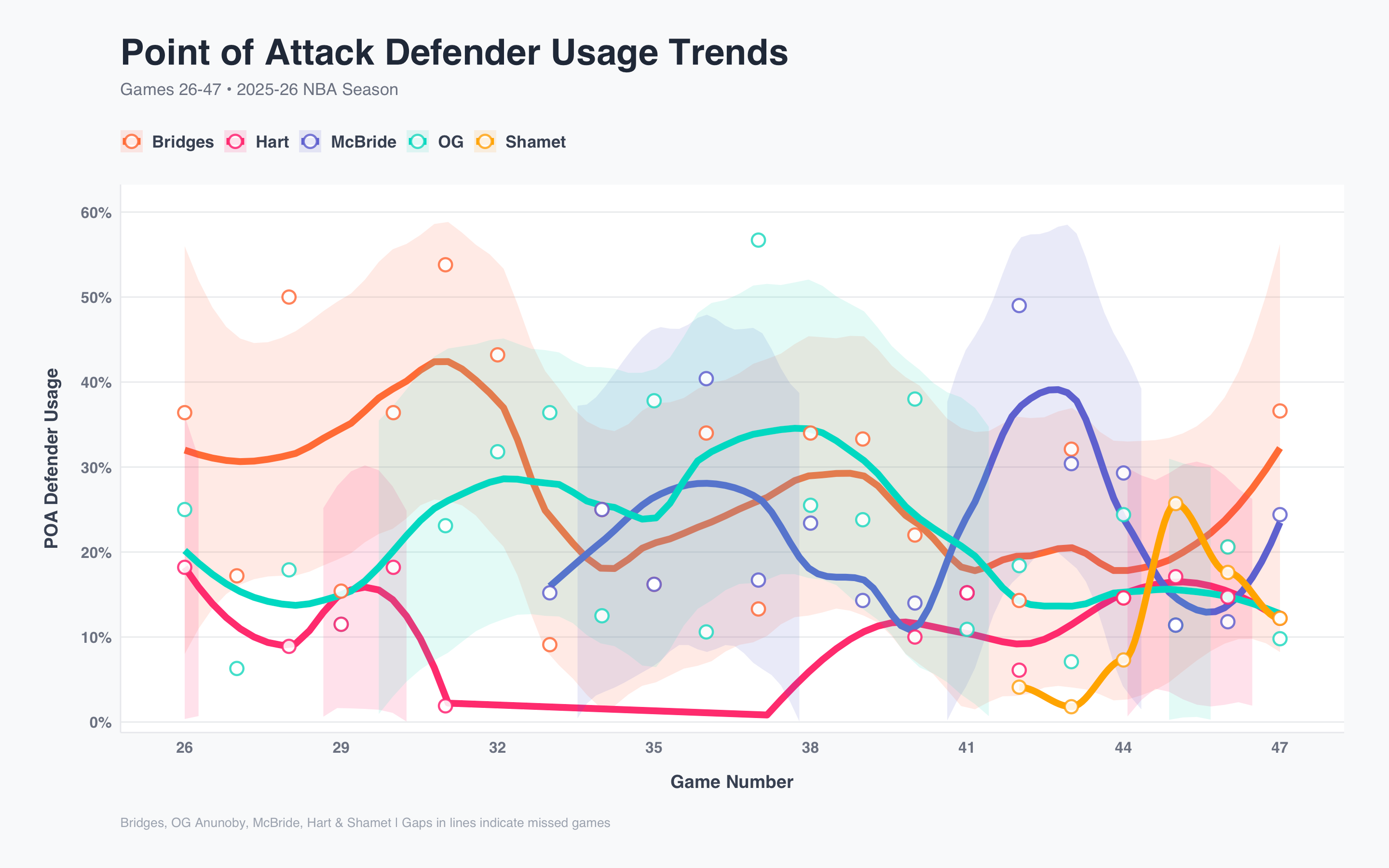
Health matters in the NBA, and that hasn’t consistently been the case for the Knicks until recently. During the December–January stretch, Bridges was forced to shoulder much of the burden as the team’s primary point-of-attack defender, with McBride, Hart, and Shamet all missing time, sometimes simultaneously. That stretch, particularly games 26 through 34, reflects a heavy load on Bridges, shown by the large concentration of orange. It’s worth noting Mike Brown’s own comments on McBride and Shamet, whom he’s described as invaluable defenders for this group. Based on both the film and the data, it’s difficult to argue otherwise.
Great article, since the “players only meeting” they’ve seem really locked in. Watching the Raptors game I saw OG cheer / yell towards the bench in excitement. The guys are enjoying it and it’s being celebrated which was really telling
The explanation and clips were really helpful. I hope the Knicks can keep this up, and that Kat can find his groove offensively and defensively