How Good is Landry?
Statistical Breakdown

Landry Shamet came into New York’s camp on a non-guaranteed deal, there was no real expectation he’d even make the roster. I still remember the debates: Garrison Mathews over Shamet, and somehow love for Ben Simmons entering the discourse this summer. At one point, it felt like the Knicks would need to make a whole roster move just to keep both Shamet/Mathews and Malcolm Brogdon. Fast forward, and the picture couldn’t be more different. They pick Shamet over Simmons, Brogdon ends up retiring, Shamet claims the spot from Mathews, and he hasn’t wasted the opportunity. He’s made his presence felt on the floor and, just as importantly, earned the complete trust of Mike Brown.
I wanted to write this piece to put a bow on that hectic cycle, to officially make it clear that Landry Shamet holds the spot. He’s in the rotation, he’s making an impact, and he’s here to stay. Let’s take a look at how he’s earned, and held his place.
FLAMETHROWER
And it’s not just any three-point shooting. There’s a clear distinction between standstill shooters and movement shooters, and Shamet firmly falls into the latter category. He’s comfortable relocating, getting to his spots, and getting the shot up quickly while on the move. That ability makes him a malleable, scheme-friendly shooter, even with a lower release point. It’s a different profile than a shooter like OG Anunoby, whose length and frame are better suited for stationary looks, where he has the time to fully square his shoulders.
On this inbounds set, Landry Shamet leverages his quickness coming off an off-ball screen to generate a three. The pass isn’t perfect, but he still secures it, flips his hips, and gets squared to the rim almost instantly. That’s the value Shamet brings, and what the Knicks sorely missed while he was injured. He’s a shooter who can convert while in full sprint, which adds a layer of shot-making this offense struggled to replicate at the time.
Here’s another play, coincidentally on an inbounds set, where he’s sprinting and looks to take a three off a handoff. Link to the play:

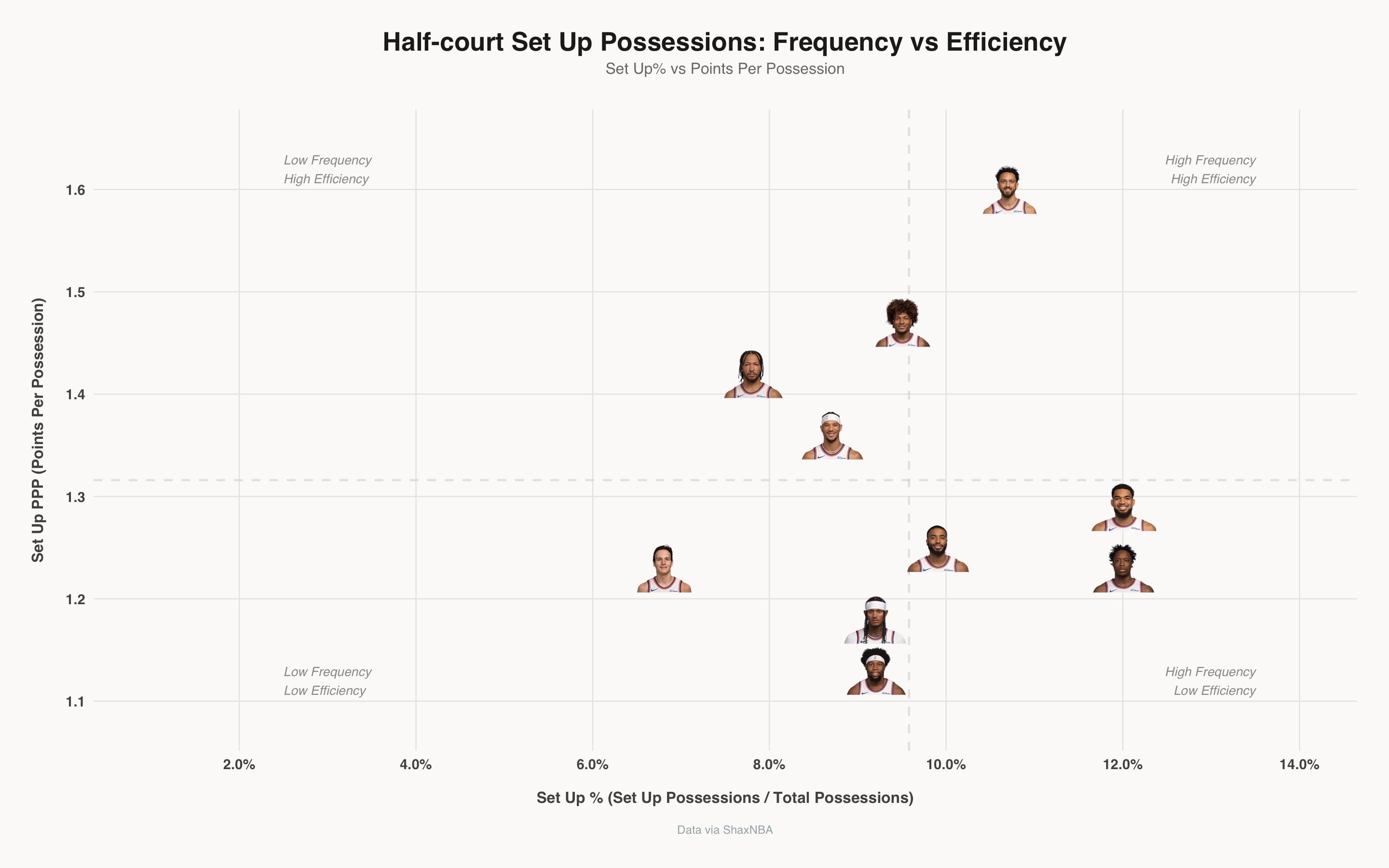
Shamet’s offensive impact on the Knicks is best captured through his set-up numbers. For Shamet, this metric highlights a player who not only gets assisted frequently, but also converts those assisted opportunities at a high rate. Given that Shamet is primarily a three-point shooter, his profile here is especially impressive. He takes 11.3 threes per 100 possessions (84th percentile at his position), yet still posts gaudy efficiency in these assisted scenarios, underscoring how valuable his movement and shooting are within the offense. Relative to the roster he has been an essential player in this category, and he does it, most importantly, in the half-court.
A Subtle Improvement
His off-ball play has helped fuel Shamet’s offensive leap, improving from a -0.3 O-DPM (68th percentile) to a +0.3 O-DPM (83rd percentile) this season. But another part of his offensive growth that’s flown a bit under the radar is his ball-handling. Under Brown, Shamet is getting more on-ball reps than last season, his on-ball usage has ticked up from 7% (9th percentile) to 8.9% (29th percentile). It’s not a massive developmental overhaul, but it is a meaningful increase. And he’s making the most of it. His decision-making has improved, turnovers are down, and the reads are cleaner:
• Potential assists: 1.8 (25th percentile) → 2.4 (52nd percentile)
• Teammate eFG% on potential assists: 64% (42nd percentile) → 74% (72nd percentile)
• Bad pass-to-turnover rate: 19.7% (4th percentile) → 13.1% (53rd percentile)
These are meaningful gains that reflect both Shamet’s individual growth and Brown’s system. Multiple players are seeing more time on the ball this season without the usual spike in turnovers, something I touched on earlier this year in a separate piece:

Take this hockey assist from last night’s game, which he delivers by handling in pick-and-roll, and turning the corner against high coverage:
Mike Brown has noted in a press conference that Shamet’s ball-handling and connectivity adds value to the offense, even referencing his point guard days at Wichita State. There’s a reason Brown trusts him with the ball. Is it a flawless part of his game? Not at all, but the increased trust he’s receiving can showcase this part, even if those gains are incremental.
Hard-worker
When Shamet entered the league, his shooting was never in question, but defense was a different story. Early on, his defensive reputation looked bleak, and it took him three seasons before he truly locked in on that end as a way to stay in the NBA. And it paid off, big time. The Knicks are certainly reaping the benefits of that evolution:
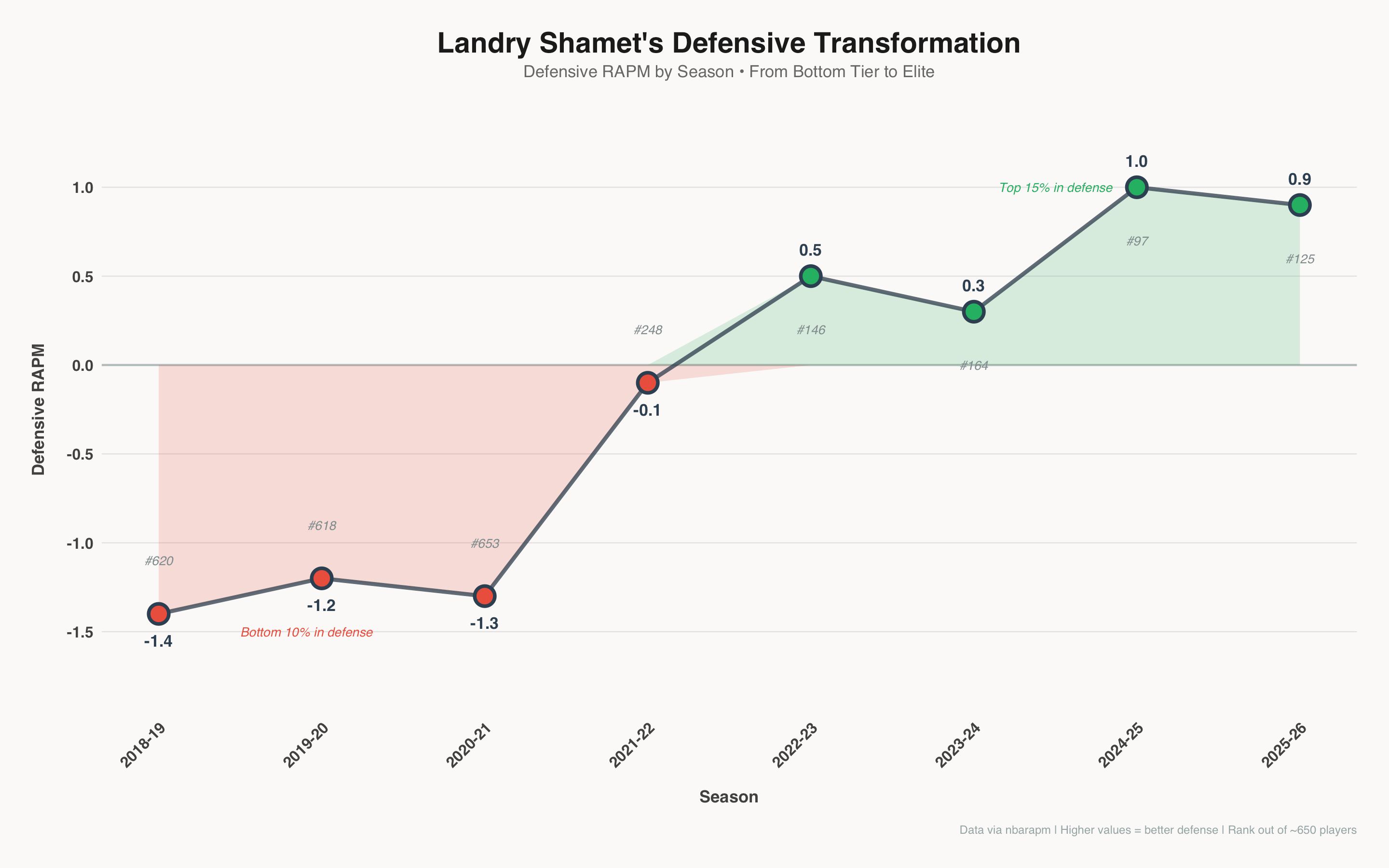
Shamet’s last two seasons have been some of the strongest defensively of his career. Brown has recognized this, calling him, and Miles McBride, the team’s best point-of-attack defenders. To go from a rookie with a shaky defensive reputation to earning that level of praise is a clear success story, and one that didn’t happen overnight.
More often than not, Shamet’s defensive role places him on the opposing team’s guard. In the previous piece, we saw that responsibility depicted after his return from injury, particularly in his usage as a screen navigator, an area where his defensive impact shows up the most:

Not sure why he doesn’t start over Josh hart. It would make the starting 5 so much better
Was a night and day difference with Shamet in the rotation vs Clarkson. Great article and data that proves he’s indispensable