Brown’s Balancing Act
Rotation Visualization

Mike Brown has rolled out yet another new rotation, and it feels like we’ve said that a lot this season. Earlier on, it was mostly driven by New York’s constant health fluctuations. Now, though, it feels different. It’s less about availability and more about emergence. Mohamed Diawara is starting to look like a fixture, and slowly carving out what looks like a permanent spot in the rotation.
The Rotation
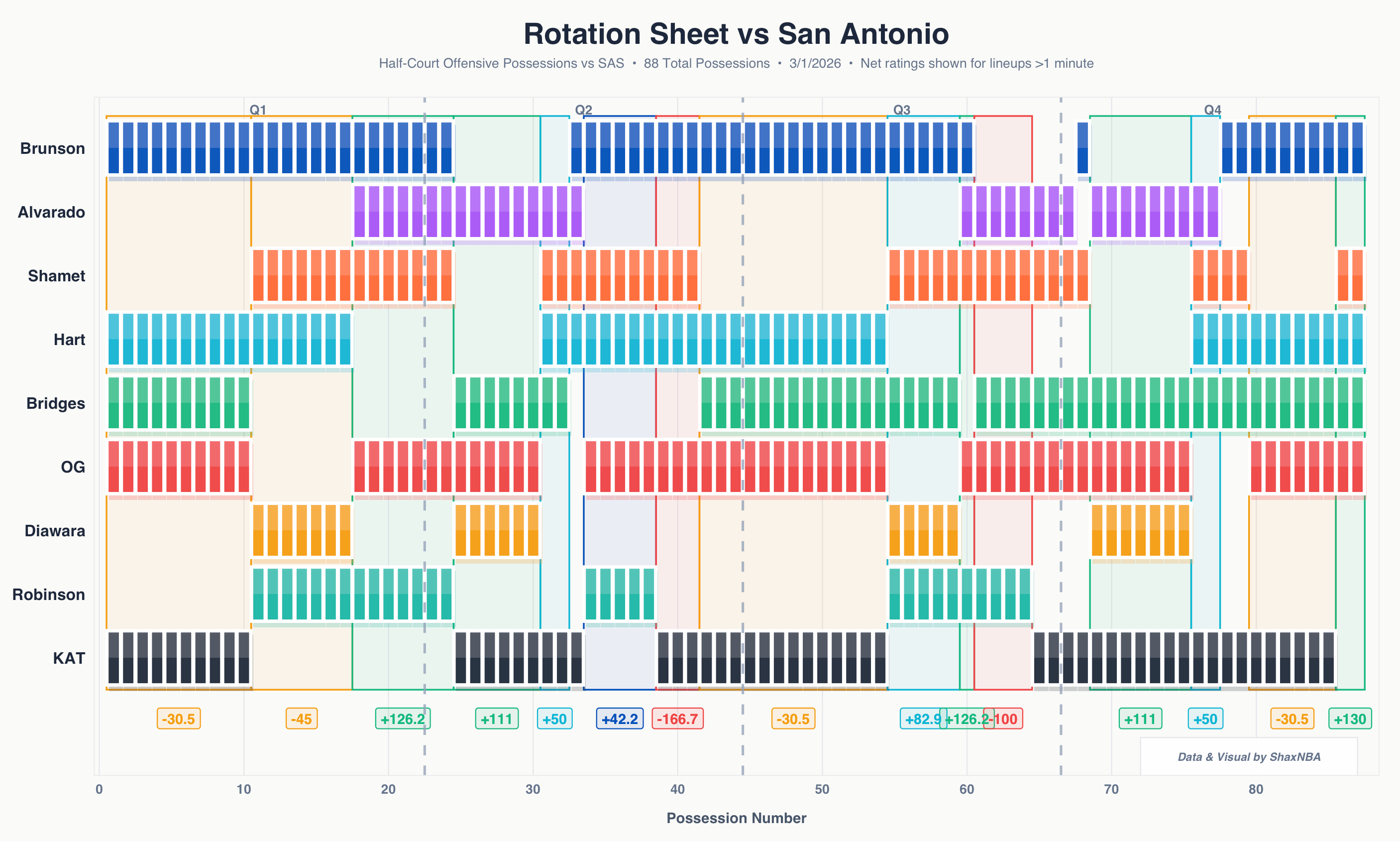
Brown has talked about finding this specific rotation recently and wanting to be consistent with it the last couple games. Here’s a quick breakdown on three of the lineups he’s went with the last two games:
Starting Lineup: Brunson-Hart-Bridges-OG-KAT
The good ole starting five. This unit has been polarizing over the last couple of years; I could write a whole article on it. On paper, it checks every box, two of New York’s best wings, the Brunson–Karl-Anthony Towns pairing, and Josh Hart, their ultimate Swiss Army knife who can plug almost any gap on the floor.
The issue hasn’t been talent. It’s been dealing with one specific counter. Opponents sticking their big on Hart and roaming off him. In those possessions, this lineup scores just 0.83 points per possession, a number that reflects how disruptive that adjustment can be.
In the clip, Mikal Bridges comes off the screen, but the action gets completely gummed up because the opposing big is parked in the gap, helping off Hart. The extra body, let alone the 7’4 230lb freak that Victor Wembanyama is, takes away the downhill advantage.
Hart ends up settling for a three, a shot teams are more than willing to concede in that scenario. And that’s the whole point. The coverage is designed to redirect the possession toward a lower-efficiency outcome, which is why opponents keep going to it.
That’s what makes this so concerning. It’s not some fringe bench lineup, this is the group that opens games and sets the tone coming out of halftime. The broader net rating doesn’t fully capture the issue, because teams haven’t consistently used this coverage against them. But when opponents do lean into this adjustment, putting the big on Hart and shrinking the floor, the results have skewed negatively:
Eight teams have defended Hart with their bigs for 10+ possessions in the starting lineup. The impact is stark: when this happens, the Knicks post a 98.7 offensive rating and 109.5 defensive rating, resulting in a –10.8 net rating.
When teams don’t put their bigs on him, the numbers jump to a 126.6 offensive rating and 113.9 defensive rating, a +12.7 net rating, over a 20-point swing.1
This has been a theory of mine going back to last season. While I don’t have the exact numbers, I remember this same lineup performing exceptionally well early on before slipping in the second half as opponents employed the same defensive tactic. In fact, it didn’t work in last year’s playoffs for many of the same reasons.
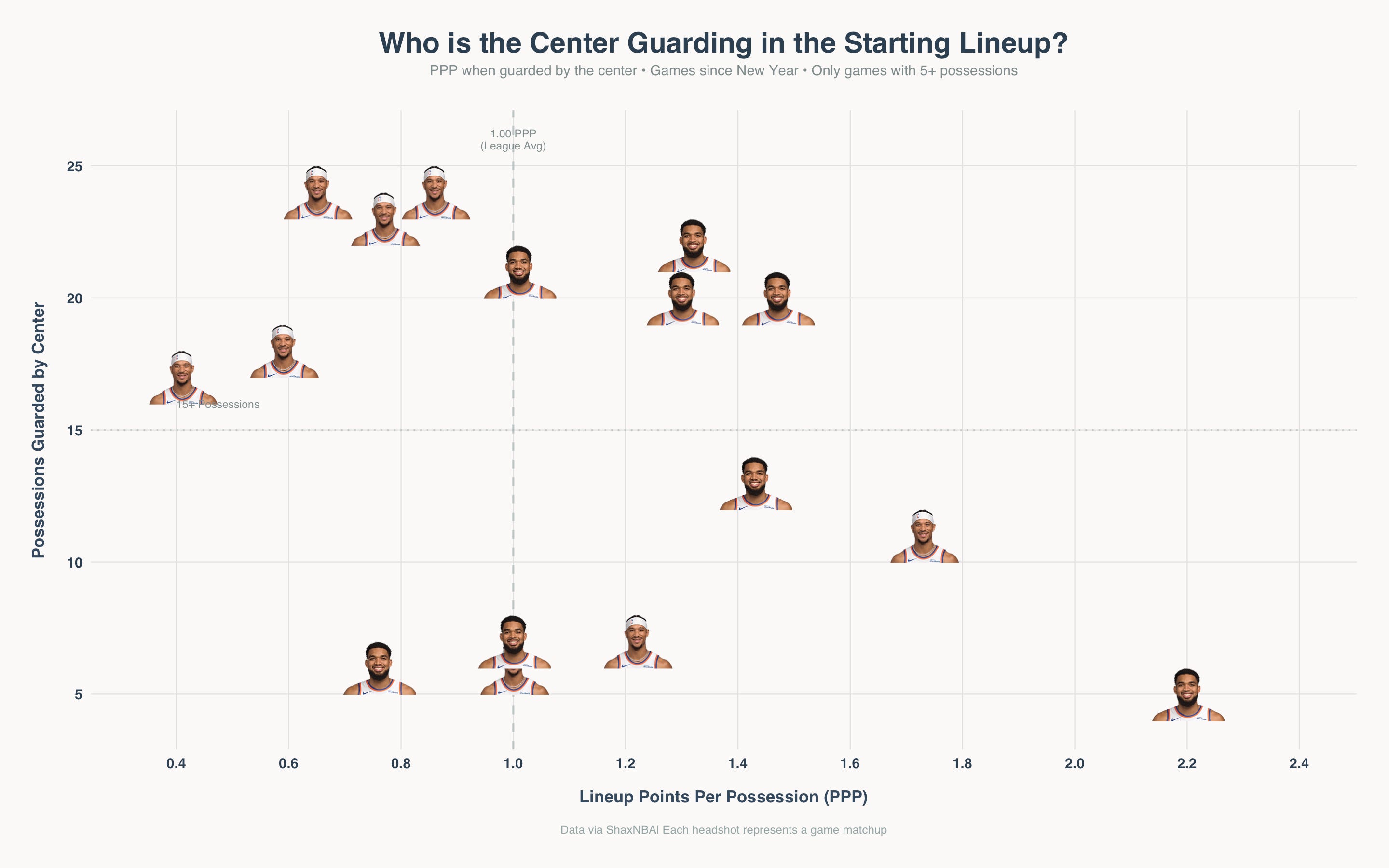
You can clearly see the difference depending on who the opposing center is guarding in this lineup, Towns or Hart. The impact on the offense has been significant, and it’s become even more noticeable lately.
Two of the 20+ possessions where the big has been assigned to Hart with the starters have come in just the last three games against Cleveland and San Antonio. Teams are going to start leaning into it more deliberately, and the Knicks have to adjust.
Thankfully, the Knicks can find solutions, or Hart can on his own, by becoming a more willing shooter. He mentioned after Sunday’s game that his confidence does waver at times, which is understandable when defenses are guarding him that way. But it’s worth remembering that the Milwaukee Bucks used the same coverage recently and the Knicks scored a more respectable 0.98 PPP across 14 possessions with that matchup. The difference? Hart shot it confidently and forced them out of the coverage.
Against the Spurs in the second half, the Knicks leaned on him more as a screener, generating 1.33 points per possession over the first nine possessions. The talent is there to exploit this coverage, but the key is consistency. Whether it’s taking the open shot or setting screens and creating opportunities for teammates. The team and Hart need to maintain that approach.
Brunson-ball: Brunson-Shamet-Wing-Wing/Diawara-Robinson
Brown’s strategy of surrounding Brunson with defenders once the starters exit has generally paid off, complementing him effectively. They’ve removed Clarkson and Kolek from the rotation to give this construction more minutes, and are now pairing Diawara with Robinson, a combination Brown was reluctant to use for most of the season.
I call this unit “Brunson-ball” because lineups with him and Robinson push his true usage rate to 58%, well above his 50% season average. I like this approach: it lets Brunson operate as the superstar he is, going on the scoring runs we know he’s capable of. He drives the offense, while the defense tightens up to support him.
Second Unit: Alvarado-Bridges-OG-Diawara-KAT
I’ve enjoyed watching this lineup the most lately, it’s defensively tough and includes willing shooters. Even when opponents try to match their centers on Diawara, the defense holds up with only KAT on the floor, no Brunson. Diawara has also maintained a consistent shooting approach, highlighting both his in-season growth and the growing confidence Brown has in him.
In fact, this coverage hasn’t been effective for opposing teams. Over 78 possessions, the Knicks have scored 1.10 points per possession. He looks to shoot regardless of the coverage, and when he is shooting against a roaming big, he scores 1.19 points per possession, showing how much confident shooting can impact the offense. By comparison, Hart in the same situation produces just 0.92 PPP by shooting. That difference has ultimately been the most significant factor between them.
Overall, this is KAT’s lineup, and we’re seeing the boost in involvement we’d expect, in what is essentially his unit. His true usage jumps from 35% overall to 46%, a significant increase that reflects just how central he is to the lineup’s offense.
Thank you to Max Wildstein for his contributions on the starting lineup data, check out his X: @MaxWildstein for more of his work, including a recent piece on New York’s big man
SHAX you’re quickly becoming my favorite Knicks content creator. Your analysis is one of one, help me here; if Hart is shooting over +40% why isn’t he shooting it more ? Is this a confidence issue? He has to keep shooting imo but stopped once they weren’t hitting and the offense looked funky
The timeout in the first when we were down in the 1Q (Robinson in while KAT sits) seemed to really get the ball rolling
My conspiracy theory is that brown is forced to start hart lol. Hart is starting to figure it out but I still don’t think this lineup will work against the Cavs/ pistons