The Other Wildcat
Data Breakdown, video

The New Orleans Pelicans haven’t been very good this season, but they do roster players who could draw interest from other contenders like the New York Knicks, whether because of contract flexibility and on-court strengths that could help a contender. Saddiq Bey is on that list.
Saddiq Bey is one of the more polarizing players I’ve evaluated. While he offers a handful of niche strengths, there are moments where he fits the definition of a “no-way player”, someone who doesn’t clearly help you on either side of the ball. That said, there are a lot of caveats to this characterization.
Strengths: Offensive Rebounding
One thing we know all too well about Villanova products is the toughness and no-quit mentality ingrained in them from day one. Saddiq Bey carries that trait with him. He’s a relentless offensive rebounder for a forward, consistently playing with an edge that shows up on extra possessions:
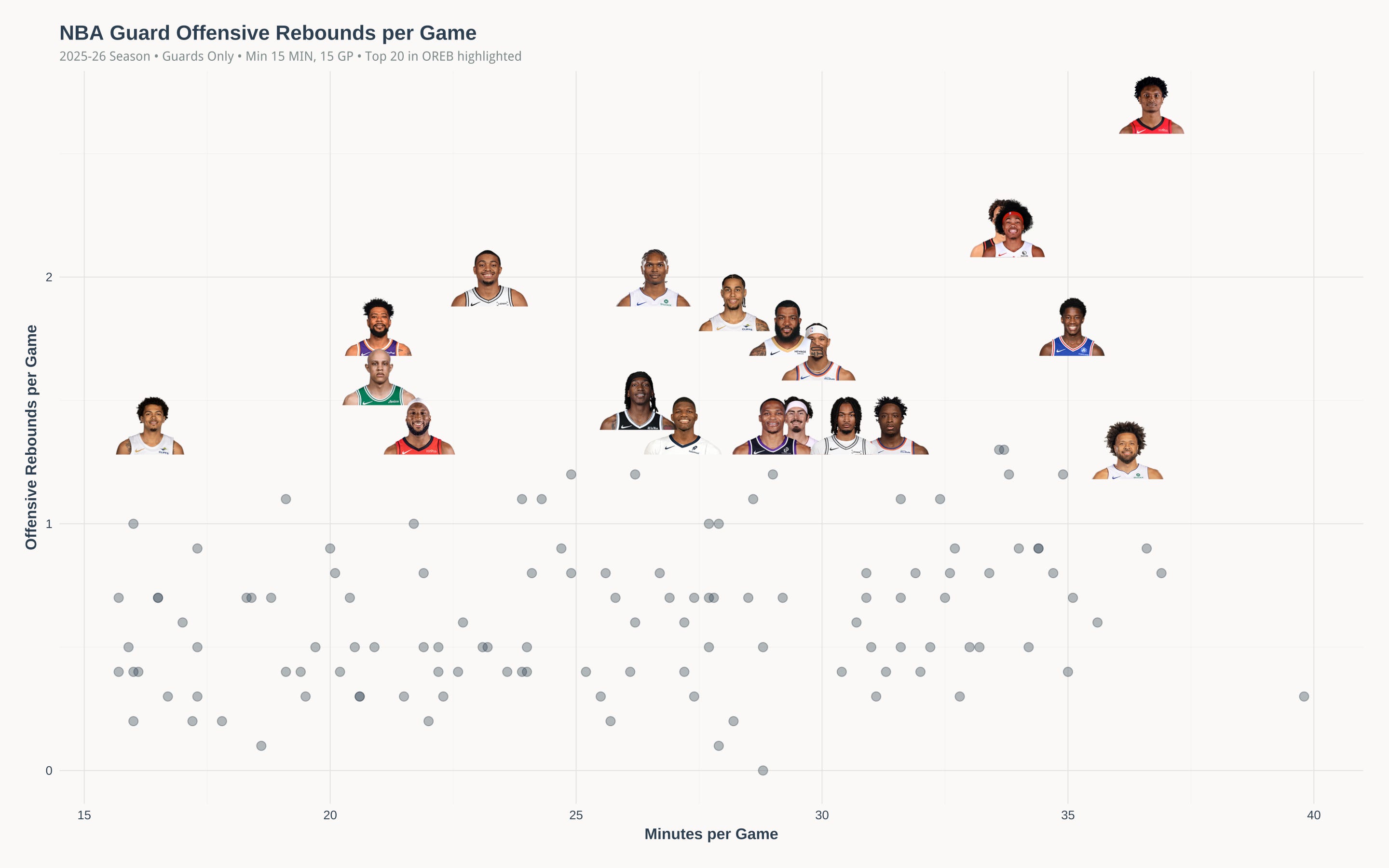
NBA.com does a poor job of labeling player positions, which complicates any attempt at clean positional comparisons. This dataset is technically pulled from the “guard” filter. When filtering by forwards, several centers appear, understandable given lineup versatility (Karl-Anthony Towns, Isaiah Hartenstein, etc.), but still problematic.
I attempted to filter by height instead, but the available ranges aren’t granular enough. The jump from 6’7” to 6’10” leaves Bey (6’8”) lumped into the 6’10” bucket, which skews the comparison. Given those limitations, this approach is the most accurate way to frame the data, and show his oREB prowess compared to a player like Josh Hart.
Watch how he crashes from the corners and seals his defender on the rebound. I’m not sure if the Pelicans have a similar approach, but Mike Brown’s system lends offensive rebounding, and generating extra possessions. At 6’8”, Bey can be an asset in that scheme. He has what some might call a “nose for the basketball.”
His rebounding numbers stand out in a meaningful way:
Strengths: Finishing and Creation Play-Types
Bey’s strengths are best in finishing play-types like transition, put-backs, cuts, and roll-man actions. Bey sits in the 98th percentile in finishing relative true shooting percentage versus league average when combining those play-types into a single efficiency metric.
These are valuable traits, but Bey is a wing, not a center. Excelling in these areas alone doesn’t impact the offensive end enough at his position. This is where his secondary value comes into play as an auxiliary handler in pick-and-rolls, handoffs, and post ups. He isn’t a high-usage creator, but he’s also not a novice scorer in these situations, particularly posting guys up. He’s scoring 1.28 PPP on 39 post ups so far on the season.
Most impressively, he takes care of the basketball. Bey ranks in the 99th percentile in creation turnover% (TOV per 100 / Offensive Load) and the 96th percentile in pass-to-turnover ratio. While his potential assists per 100 (33rd percentile) aren’t eye-catching, he will preserve possessions, something the Knicks place a premium on across every position.
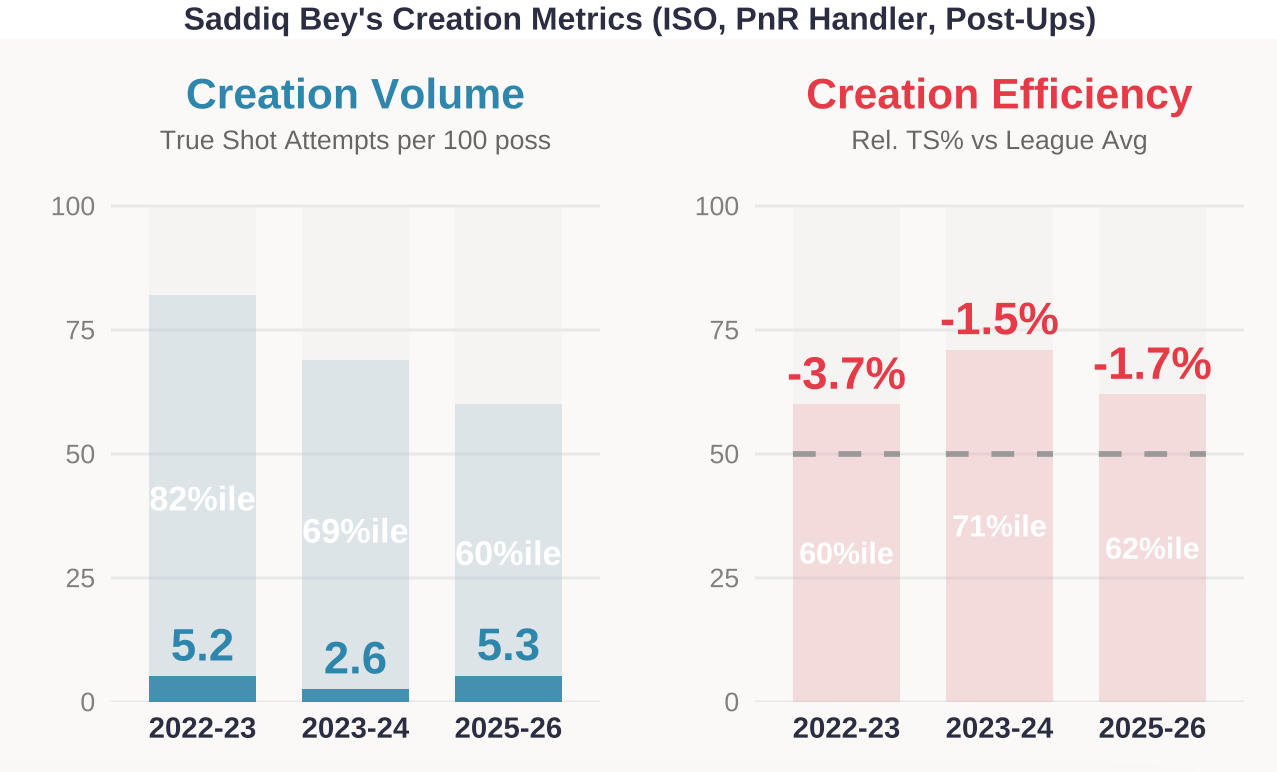
Over the past three seasons, Bey profiles as a fairly above-average creator for his position. He’s handled meaningful volume, converted his opportunities efficiently, and gotten to the free-throw line. Quietly adding value in an area that some other wings struggle at.
Weakness: Defense
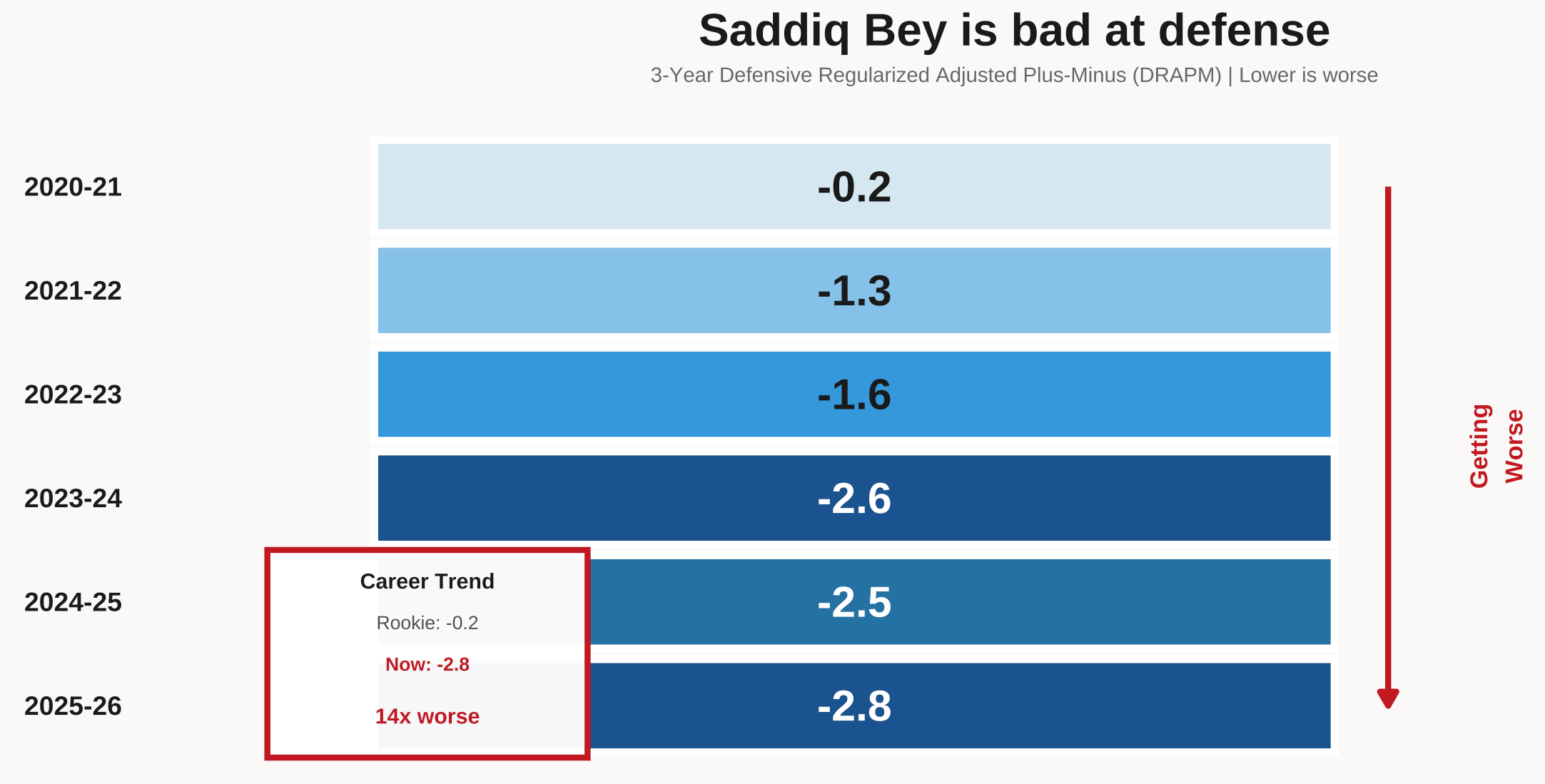
If you pull up Bey’s defensive numbers, you might be unimpressed or, like me, borderline alarmed. For a 6’8” wing, they’re atrociously poor. He doesn’t generate deflections, steals, or blocks, and he provides little to no rim protection. By many metrics, he grades out as one of the worst defenders in the league.
What does the film say? I went back and watched five Pelicans games and took some notes solely watching him:
Bey is a low-activity defender off the ball and doesn’t provide much unique value as a low man. His impact there is fairly average and largely hidden.
On the ball, he can hold his own, particularly against slower, physical offensive players. One example that stood out was New Orleans cross matching him on Alperen Şengün with Derik Queen on the floor, where Bey actually fared well and helped the Pelicans win a basketball game on both ends. Quicker guards and wings are more concerning. While he rarely reaches or fouls (94th percentile in foul rate), he lacks the foot speed to consistently switch or defend across 1–4. His screen navigation, at least on film, is subpar.
Bey does carry a high versatility rate, and despite the holes in his defensive profile, he isn’t “the worst defender in the NBA.” He just doesn’t provide much added value defensively beyond being a functional body on the floor at his height and strength, if that makes sense.
Weakness: Spot up Shooting, Middling Efficiency
When I mentioned that Bey can be a polarizing player, borderline unplayable on both ends, this is where that concern really comes into focus. His defensive profile, combined with his off-ball value as a shooter and closeout attacker, raises some red flags. These are essential skills for being an impactful player in 2025, and without them, Bey can put himself at a disadvantage when it comes to earning meaningful minutes alongside high-level players.
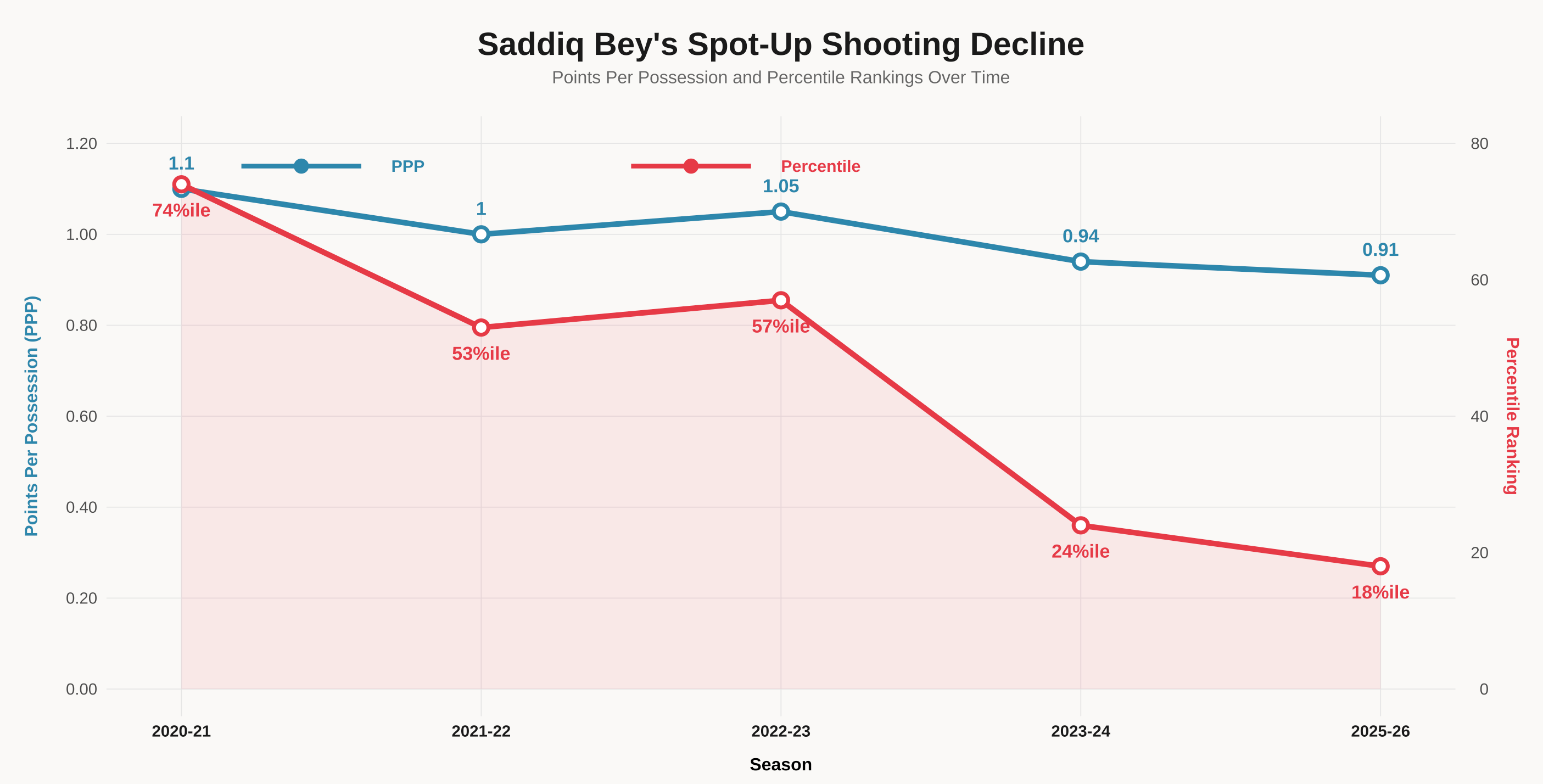
Over the last two seasons, Bey’s spot-up efficiency has declined noticeably. He’s shooting 34% on catch-and-shoot threes this season after posting 32% in 2024. Because self-creation has been his best offensive pathway, the inefficiency across multiple areas of the floor becomes more concerning:
• Rim FG%: 64% (31st percentile)
• Short midrange: 41% (48th percentile)
• Long midrange: 21% (27th percentile)
• Three-point shooting: 35% (53rd percentile)
Bey isn’t a poor shooter by any means, but he doesn’t consistently move the needle on a possession-to-possession basis. He is shooting 29% from the corners compared to 38% above the break. Interpret that however you choose, but his inconsistency limits his off-ball reliability.
Fit with New York
The Knicks are in need of another good size wing and Saddiq Bey fits that profile. Not only that, but his contract for them is very moveable for what the Knicks can look to package together for him. On paper the move should be an automatic yes given what the Knicks have gotten, or in this case, haven’t gotten from Guerschon Yabusele.
That said, the concerns are real. Bey’s defensive shortcomings and inconsistent off-ball value raise legitimate questions, and if those issues persist, the Knicks would be carrying his contract into another season without clarity on his role. Still, at 26 years old, there’s room for growth, particularly in a winning environment. Given the state of the market and the Knicks’ current lack of wing depth, I’d be okay with Bey as a deadline addition. I would not be especially enthusiastic, but I wouldn’t view it as a mistake either.
Great stuff as always! I’ve been eyeing Bey myself. I kinda want Mike Brown to give Yabu more minutes and see if the vote of confidence gives him the mojo boost the eye test tells me is most of what he’s been lacking. But I’m a midwit at best; what do you think? I feel like a similar principle might apply to Justin Champagnie and Keon Ellis; both of those guys are inexplicably playing limited minutes and their numbers are down compared to last year. Those guys wouldn’t require us to give up more than one player as long as we’re willing to part with significant draft capital.
I watch a lot of Pelicans cuz of Zion.
I don’t get the fascination with him , but at least he’s better than Jordan clarkson lol