Misses That Matter
Statistical and Visual Breakdown

The Knicks are a top ten team in Offensive Rebounding Percentage and spent much of the season inside the top five. A large part of that success comes from Mitchell Robinson’s dominance on the offensive glass. Robinson owns a 22.1% Team Miss% , the percentage of teammates’ missed shots he rebounds, a mark that ranks in the 100th percentile among centers. In this piece, I want to explore which players benefits the most from those second-chance opportunities, and look at the data a bit closer.
What to Expect
Offensive rebounding is one of the most efficient scoring avenues league-wide. I attribute the chaos to mirroring a transition opportunity within the half-court. For New York, this holds true. According to my data, the Knicks score 1.19 points per possession off offensive rebounds in the half-court, plays I classify as “broken plays.” For context, New York averages 1.01 PPP in standard half-court possessions, already placing them among the league’s best in that setting.
It’s no surprise that 51% of broken plays result in shots at the rim, driven largely by putbacks. That alone explains part of the efficiency. But it’s not the whole story. Broken plays also generate open three-point opportunities, particularly catch-and-shoot looks. For the Knicks, pull-up threes account for just 2.9% of broken-play attempts, compared to roughly 10% in their normal half-court offense. The distinction matters: these possessions shift shot quality from self-created attempts to assisted looks, further boosting efficiency.
So who are broken plays impacting the most?
The Unexpected (unless you expected it)
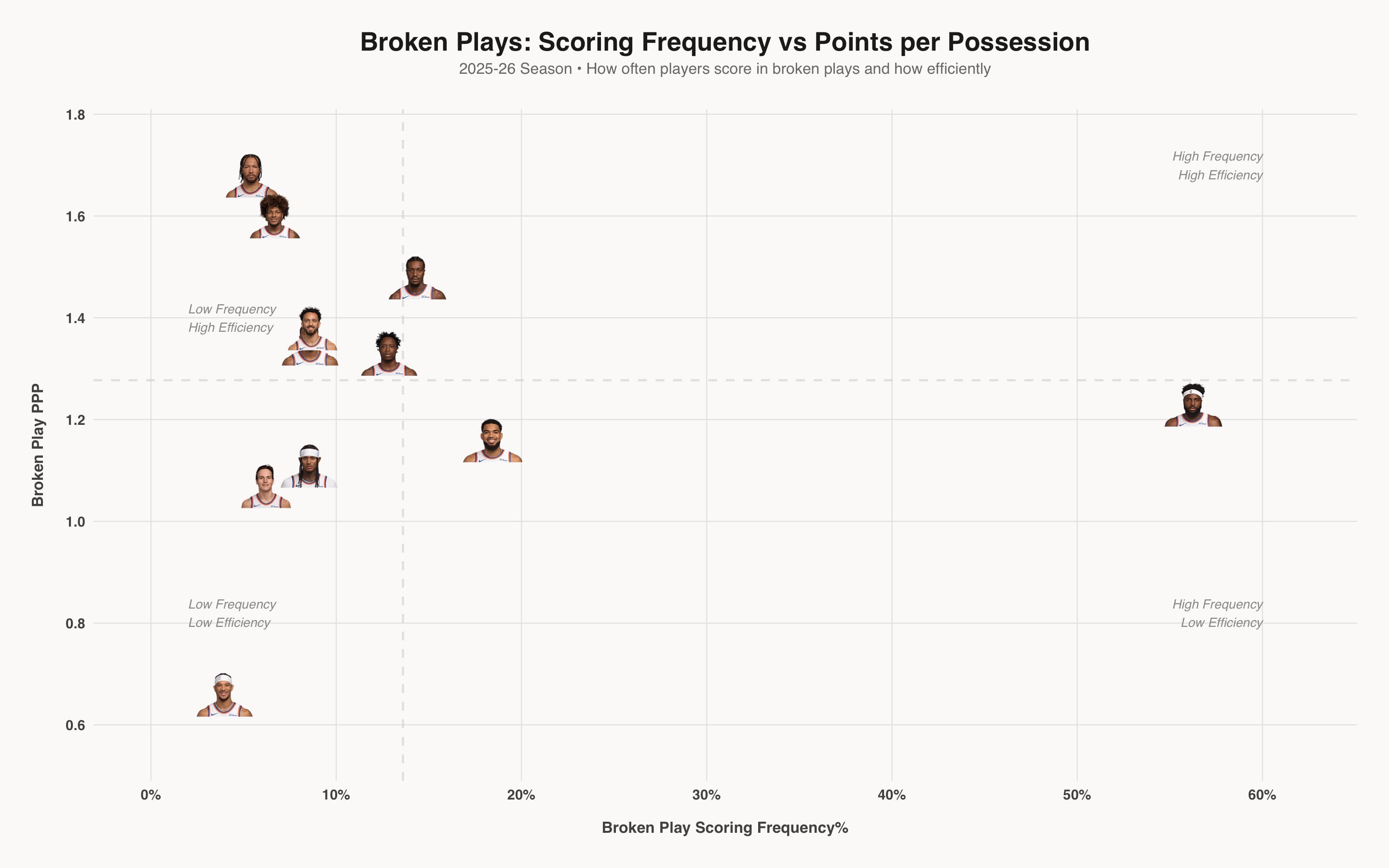
Right away, Mitchell Robinson’s scoring frequency jumps off the page. 56% of his half-court scoring comes on broken plays, a figure that completely dwarfs the rest of the roster. The next closest player is Karl-Anthony Towns, who sits at roughly 18%. Both numbers align with each player’s offensive role, but they raise an important question: are these possessions actually dominant?
For both Robinson and Towns, the putback play type makes up the majority of their shot diet in broken-play situations. Despite that, neither has been particularly efficient by league standards. NBA.com lists Robinson at 0.99 PPP (26th percentile) across 76 possessions. In my tracking, however, Robinson scores 1.18 PPP on 58 half-court putback possessions. That discrepancy suggests either a data classification difference or that the additional transition possessions included by NBA.com are significantly dragging down his efficiency in this play type, which in itself is interesting.
That same ambiguity doesn’t apply to Towns. NBA.com has him at 1.01 PPP (32nd percentile) on 114 possessions, while my half-court data shows 1.05 PPP across 103 possessions. Regardless of the source, the conclusion is consistent: Towns has struggled mightily as a putback scorer. What about those that benefit?
Those players would be Jalen Brunson and Miles McBride. Both guards thrive in broken-play situations, posting strong point totals while converting at a high rate. As outlined earlier, much of this success stems from their three-point shooting prowess, particularly their ability to capitalize on breakdowns created by offensive rebounds.
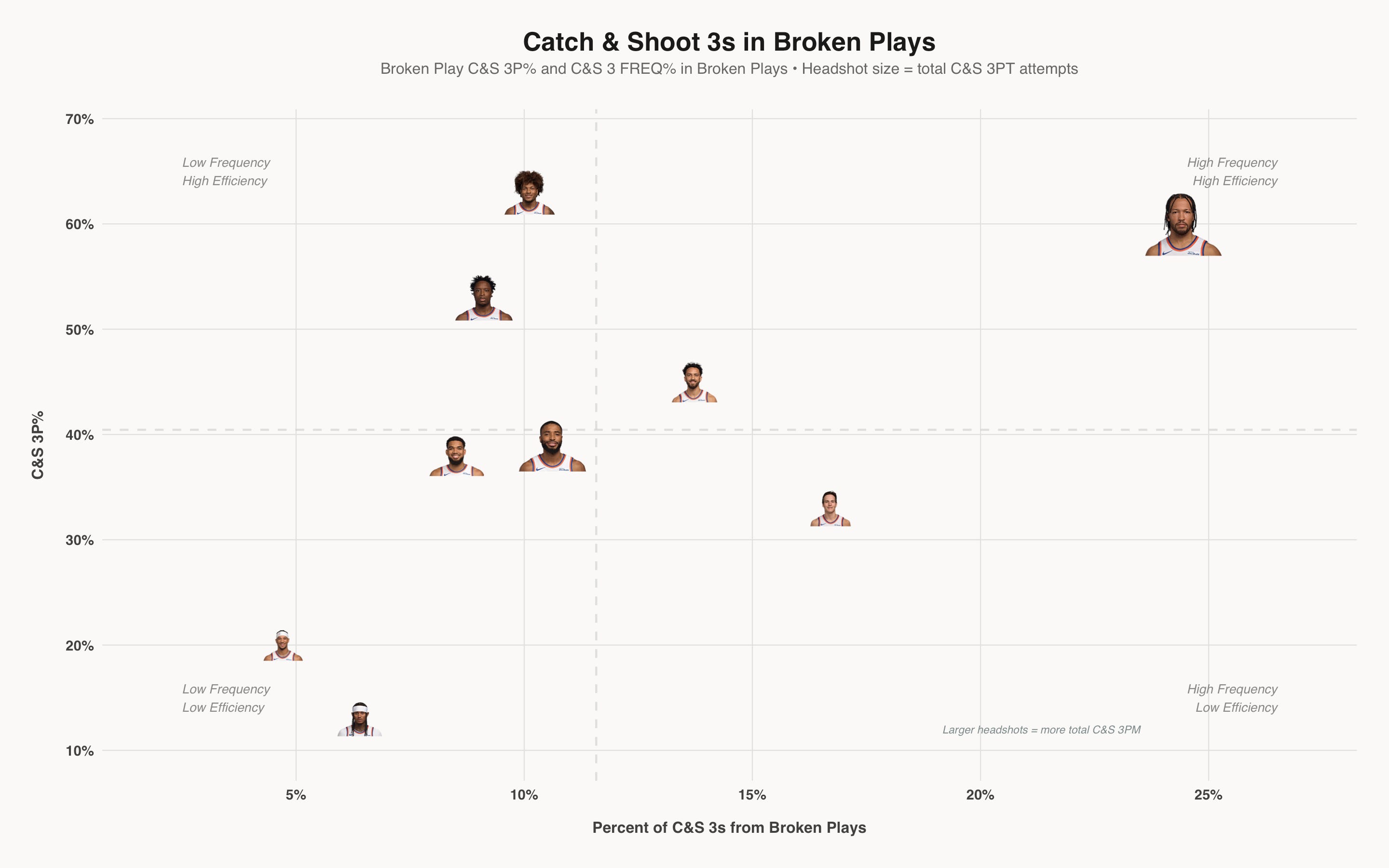
Yes, that’s real. Of Jalen Brunson’s 131 half-court catch-and-shoot threes, 24% have come off an offensive rebound. He’s taken 32 catch-and-shoot threes in these situations, making them a substantial share of his catch and shoot diet. The gap in volume isn’t even close compared to the rest of the roster. No other Knick comes near Brunson in either opportunities or attempts generated off offensive rebounds. At that point, it’s fair to wonder whether New York actively looks for Brunson in broken plays to manufacture off-ball threes for their best scorer.
In fact, Mitchell Robinson has served as the potential assist man for Brunson eight times on these broken-play possessions. That may not sound like a huge number in isolation, but it towers over the rest of the roster. The next closest players, Bridges, Anunoby, and Towns, are all tied with just three. The gap reinforces the idea that Brunson separates himself from the pack in getting additional scoring opportunities.
If we expand beyond just catch-and-shoot threes and look at Brunson’s spot-up opportunities, the trend holds. 23% of his half-court spot-ups come from broken plays, a massive share for a primary on-ball creator. The next closest Knick is Tyler Kolek at just 14%, a sizable drop-off that further separates Brunson from the rest of the roster.
Broken plays aren’t just a secondary benefit for Brunson, they’ve become a meaningful, repeatable source of efficient off-ball offense for him. He shoots 60% on these catch and shoots 3s, and posts a gaudy 1.69 PPP in spot up chances.
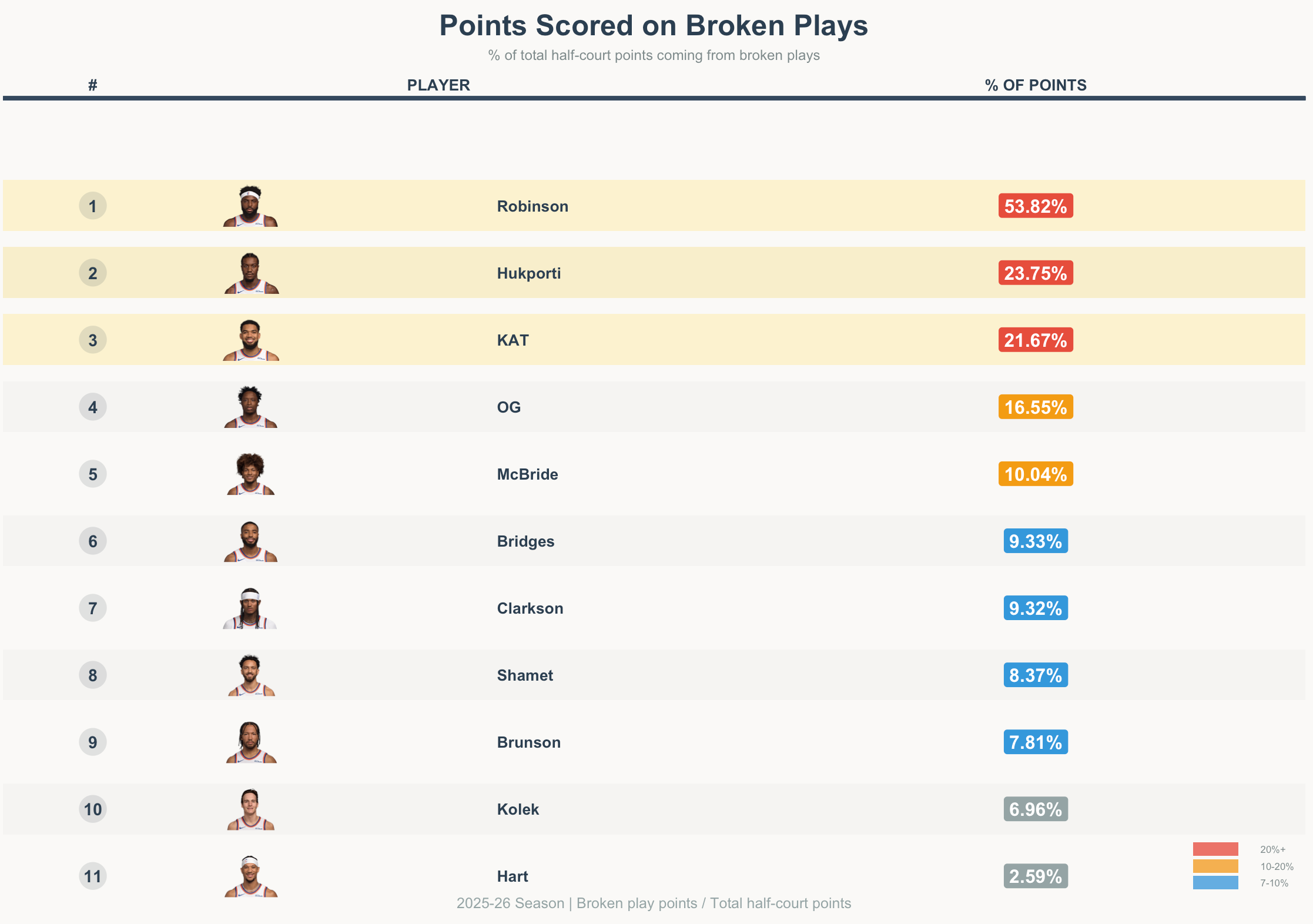
When looking at pure point totals (the y-axis on the first plot), it’s expected that the centers account for a large share of their scoring through broken plays, with Mitchell Robinson towering above the rest at roughly 54%. Brunson appears lower on this list, which makes sense given his broader half-court responsibilities. He’s the only Knick with over 720 half-court points, with Towns the next closest at 720. His offensive burden naturally dilutes the share of his scoring that comes from broken plays.
The real standout, in my view, is OG Anunoby. Among non-centers, he scores the largest proportion of his points via broken plays relative to his half-court production. There are a few reasons for this. OG can space the floor effectively in these chaotic situations, but he’s also a legitimate putback threat. He’s currently shooting 53% on 17 catch-and-shoot attempts, owns a 1.32 PPP mark on 25 putback attempts, which NBA.com places in the 77th percentile, and posts 1.37 PPP on 27 spot-up possessions. Like Towns, he functions as a dual threat in broken plays. The difference is OG converts his putbacks.