Minimal Changes, Big Results
An Investigation into New York's "new" Offense

Plenty of coverage surrounded New York's change in play-style entering Game 4 of the first round against the Atlanta Hawks. I wanted to compile the most important quotes from this event, while showing you my perspective on what I'm seeing and what made the difference, both on film and in the numbers. Overall, the change succeeded, but the accompanying reaction blew it out of proportion, and we'll see why.
Premise

If you don't already know by now, Mike Brown made a notable change to New York’s offense in Game 4 of the first round, allowing Karl-Anthony Towns more operation in the pinch-post as a hub. The article above does a great job painting this picture of New York's changing offense. I won't post everything from it, but here's the most important piece we'll use:
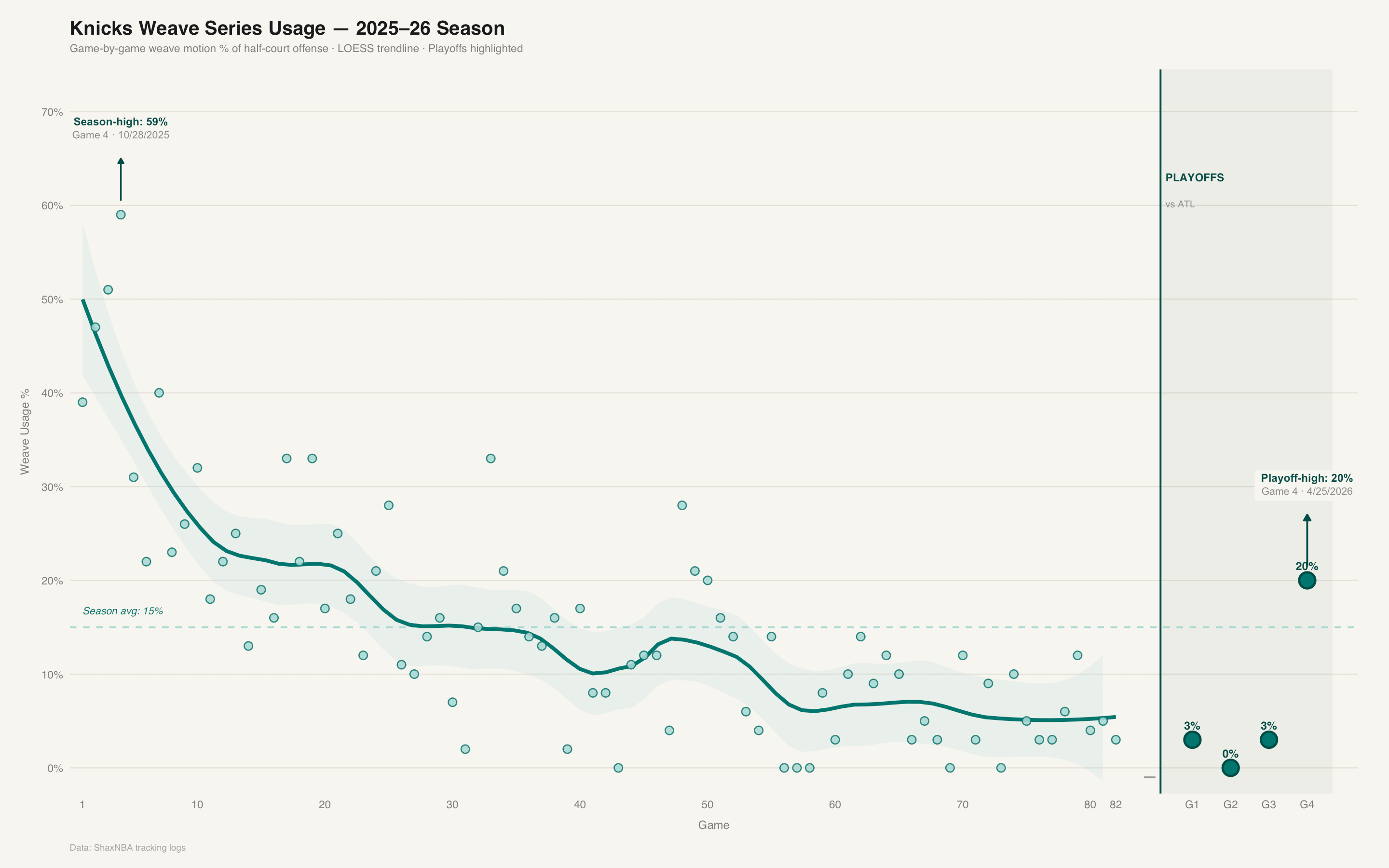
Notice the spike in "weave" series usage. That essentially describes the pinch-post/hub offense, and what we'll discuss today. The Knicks leaned on it heavily during the early season and sparingly throughout the rest of the year, but never fully shelved it. Brown "hiding" this type of offense tops the list of the biggest misconceptions this season, and plenty of the quotes seem to support that. Towns recently told the New York Times that “he'd asked for it [hub] all year.” Along with Mike Brown mentioning how they can expand on it come next season with a full training camp as if the Knicks have never attempted it.
Clearly, a disconnect exists. The data directly from the film shows that Towns ran pinch-post/hub plays multiple times during the season in fact, I counted each specific play in which this occurred with Towns defended by a center:
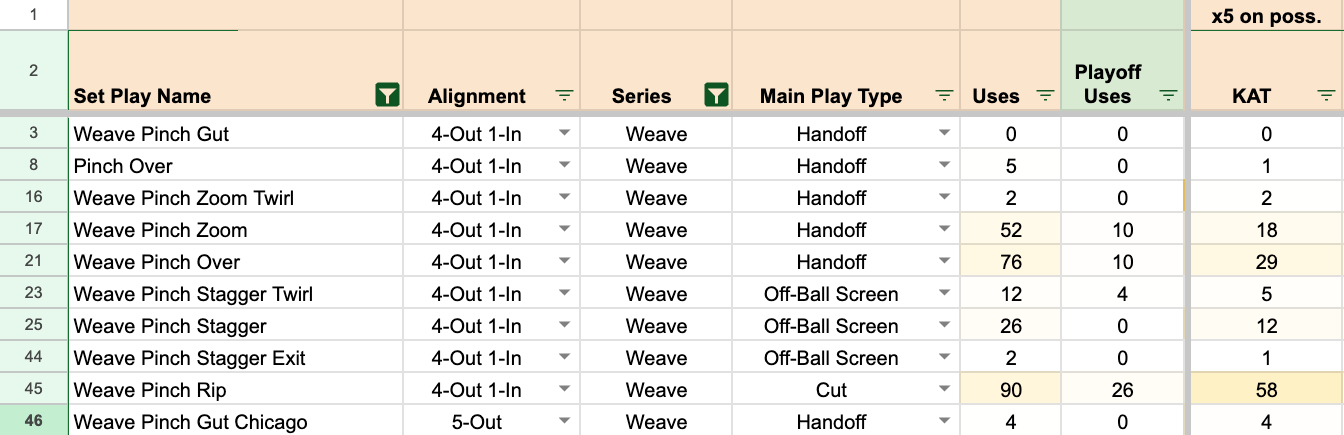
Quotes like these from Brown and Towns signal a change significant enough to warrant attention, and I have the answer. Within my tracking, I break the “weave” section of the playbook into two distinct categories: motion offense and set-play offense. The difference lies entirely in how the play gets initiated. That distinction matters here, while the core idea remains the same, Towns as the hub, the initiation and focus changed completely.
What Did Towns Ask For
Knicks offensive assistant coach Chris Jent provided some of the best context on this switch. Jent readily acknowledges that yes, the Knicks attempted to run the pinch-post/hub offense during the season:
“We had a couple flow offenses early in the year..based upon guard play, and KAT just…”
“Our numbers were always really good off ball, and we were running a decent amount of off ball, but it fluctuated.”
- Chris Jent on Mike Brown making the round 1 change
via Sirius XM NBA Radio
What Jent refers to as the flow offense “based upon guard play,” I refer to as the 4-out 1-in motion offense or “weave”, and I’ve shown and broken it down plenty of times throughout the season including the full playbook of it.
Keep in mind that the flow offense relies on concepts, where players make their own reads based on the defense. Look at the center in these clips. While operating in the dunker, the center must read when to pop out, a decision that can trigger other actions once he catches the ball. So, there’s a variety of other actions that exist within the concept, as New York did not have a set-play hub action.
Jent trails off when he mentions Towns, almost as if he doesn't want to admit that pushback existed against this type of offense. I alluded to that during the season, because in March, the Knicks rolled out a whole new system built for Towns to succeed:

That can make things even more confusing. If Towns pushed for the hub offense during the season, why did he pushback against the motion system, enough to make the Knicks change the offense almost completely? I believe it comes down to indecision, he struggles deciding when he should come out of the dunker, and he faces a lot of thinking before he even receives the ball. Towns wants the hub without the thought process, and Jent would go on to explain the change for exactly that:
“And coach [Brown] was just like forget it…we called him [KAT] our hub, we’re just going to play through KAT as our hub at the elbow.”
“Forget about our other flow actions, we’re just going to this, we’re going to wear it out.”
What does “wearing it out” look like?
The Knicks responded by stripping away the movement and handoffs when parking Towns at the elbow. They sometimes look to disguise the action with a brush screen, getting Dyson Daniels off Brunson so Atlanta can’t switch the off-screen action as easily, and had Towns start low, but the real difference resides in cutting out the extra movement simplifying Town’s outlook. Instead of wondering whether he'll receive the ball, he knows for certain it's coming his way.
Sometimes they don't even need to set a brush screen, Towns simply sets up at the elbow to receive the ball. Notice how this new setup can function as a perimeter isolation or post-up play for Towns, especially if he draws a smaller matchup and can punish that player by overwhelming him with size. Put yourself in Towns's shoes, and this change starts to make sense as one he asked for earlier. He receives the ball without extra movement, nobody forces him into a decision, and the play exists just for him, in a season that saw a lack of post-up and isolation chances. Picture the change as using the hub portion of the motion offense, throwing Towns the ball first before any action starts, running the offense through his catch rather than before it.
Mike Brown has a point, multiple ways exist to build off this type of offense. The Knicks could implement all the pinch-post actions that worked during the season within the motion system, while also giving Towns freedom to isolate and post up. We could see a more aggressive and set-up version of Towns next season, one whose field goal attempts don't get cut the way they did this year. This doesn’t mean to totally abandon the flow offense either, as they ran it in conjunction to the new set-up.
Extent of Production
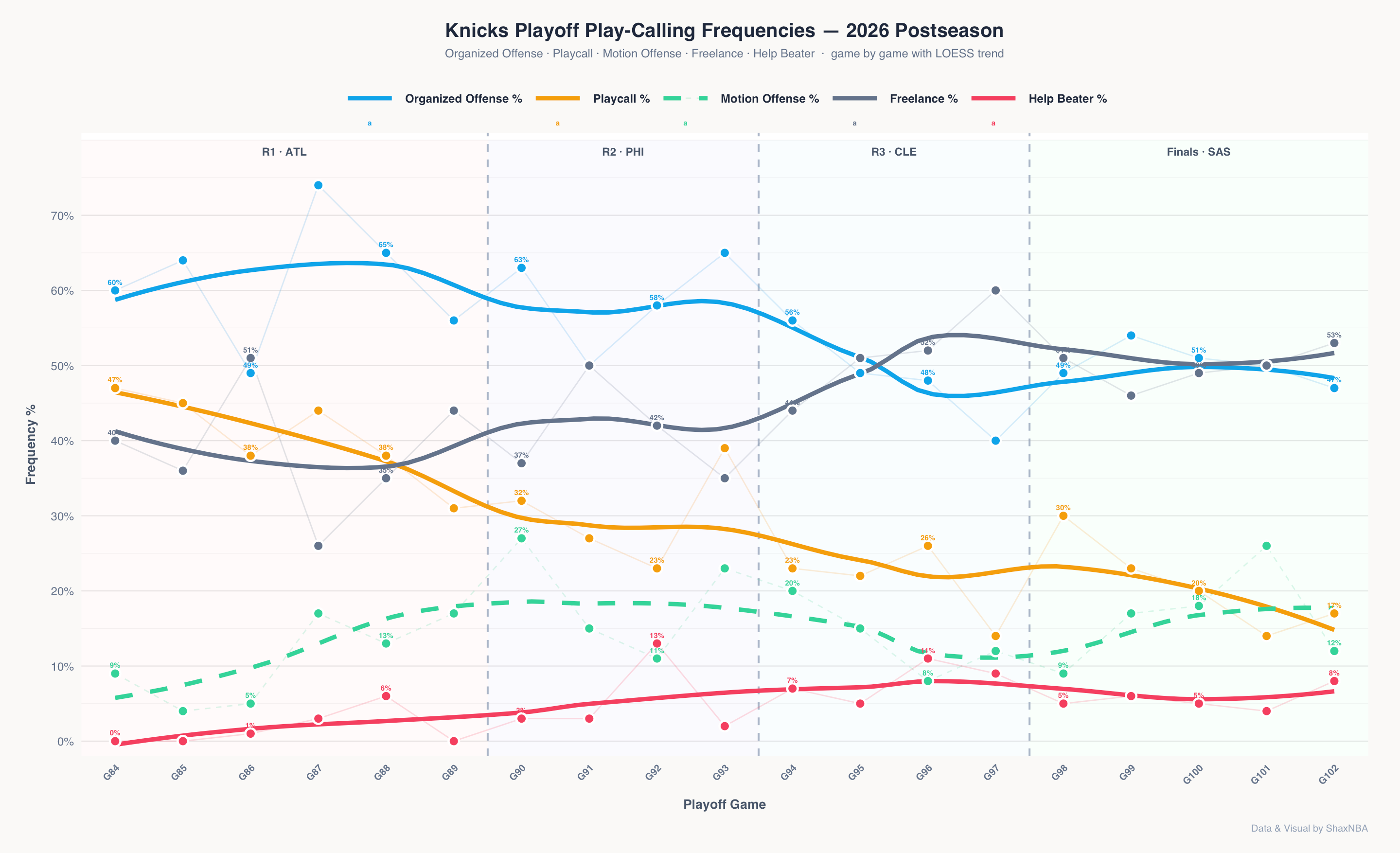
Another misconception suggests that New York simply handed Towns the hub role and rode that to championship success. The scheme instead changed significantly during the Cleveland series and into the matchup against San Antonio. The main point stands that the Knicks have multiple ways to win basketball games that have nothing to do with optimizing Towns. Does optimizing him make things easier? Yes. Can the Knicks get away without it? Yes. Each opponent presents different weaknesses, and exploiting them in a variety of ways matters more at the end of the day.
The Knicks moved away from heavy play-calling, leaned into more freelanced offense, and incorporated help beaters down the stretch. That placed a heavier on-ball burden on Jalen Brunson against tougher defenses, but it ultimately led them to a championship in dominant fashion. For a deeper dive into New York’s less talked about offensive revision, check out the piece below:

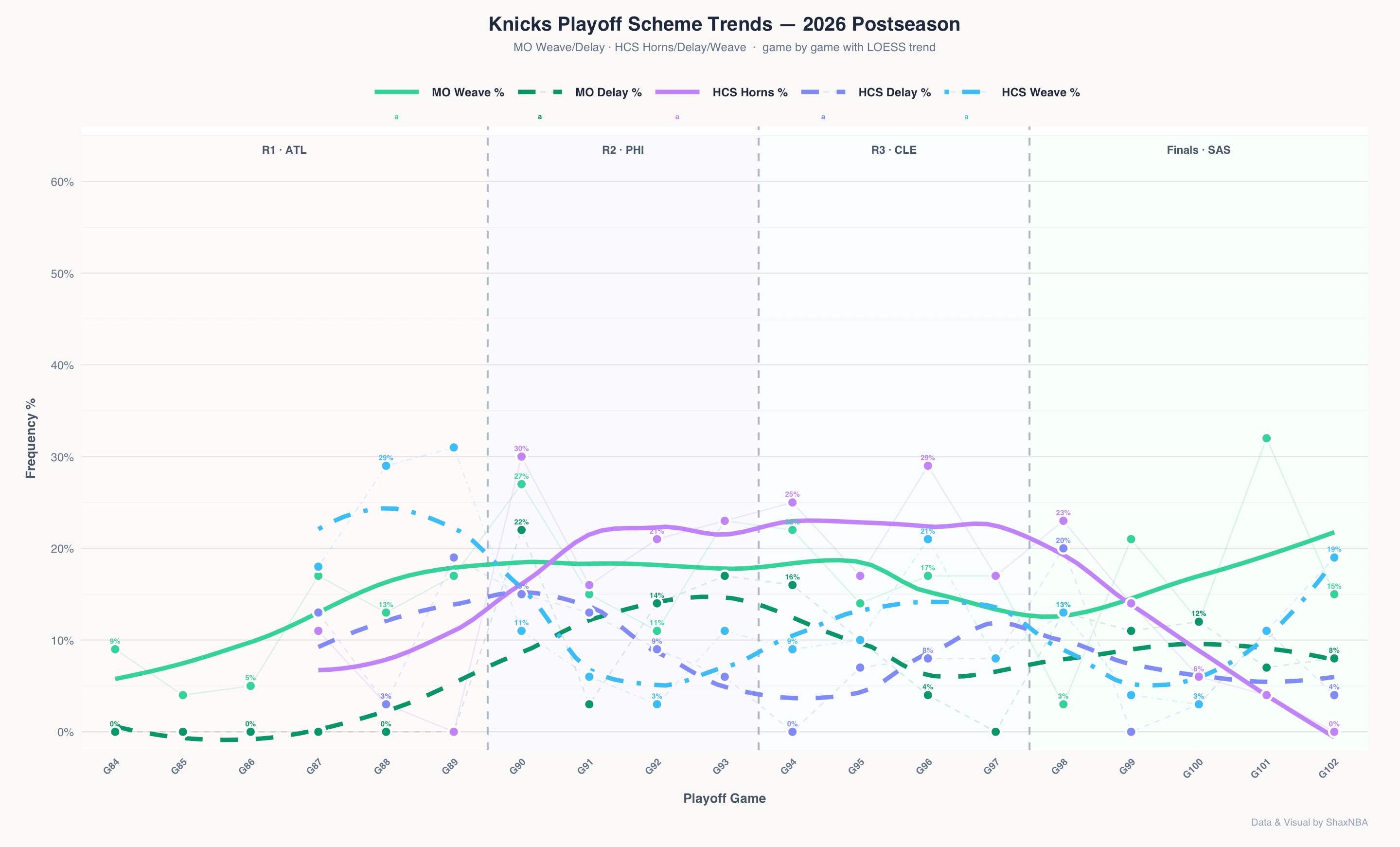
Breaking the playoffs down by scheme gives an even closer look into their schematic adjustments, and can help curate a timeline:
Round 1 vs. ATL
HCS (Half Court Set) Weave the signature action, climbed sharply from 18% to 31% by the end of the series. We’ve already layered this context as the new pinch post set up
Horns barely played any role (nearly at 0%)
HCS Delay spiked to 19% in the series’ final games. Brown installed the half-court Delay offense as a major addition in March.
MO (Motion Offense/Flow) Weave stayed in the high-teens, and MO Delay wasn’t used at all.
Round 2 vs. PHI
Horns explodes as the new primary action, opening at 30% and settling in the high teens to low-20s the rest of the series. Mostly looking for Mikal Bridges to attack drop coverage through Horns Out, read for more.
MO Delay, which didn’t exist against Atlanta, suddenly appears and peaks at 22% in the series opener.
HCS Weave collapses to single digits (as low as 3%), essentially swapped out for Horns offense. They ran the new pinch post offense set-up not nearly as much as Atlanta, instead opting for the motion offense.
Round 3 vs. CLE
Horns remains as the dominant scheme, staying in the high-teens to high-20s
MO Weave climbs back up into a stable 14-22%.
HCS and MO Delay gradually fade out toward the end of the series (16% down to 0%).
We see a lot of matchup hunting and help beater usage during this series
Finals vs. SAS
Horns, which had been the backbone series since Round 2, completely dies off falling from 23% to literally 0% by the closeout game.
HCS Weave climbs back to 19%, and MO Weave to 32% in Game 101, the single highest reading of any scheme metric across the entire postseason.
A large part of this series centered on hunting San Antonio's centers on the perimeter and combating their unique tactic of creating a one-man zone, keeping their big anchored in the help area no matter what.

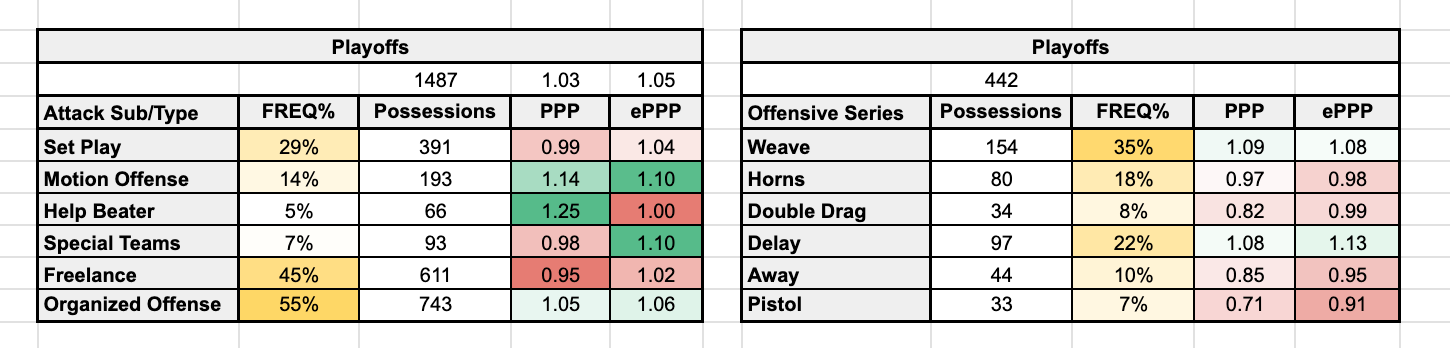
On the efficiency front, the motion flow offense truly shined in the postseason, with Delay and Weave usage picking up the slack where set plays fell short. Help beaters proved majorly successful, and the overall play-calling trend stayed the same, with organized offense posting a +0.10 PPP increase from general freelancing in the half-court.
yepppop