
Something I’ve encountered consistently around NBA discourse is the value of size. In today’s NBA, size has evolved dramatically, including players who bring multiple high-value skills. These players represent the gold standard. They can move exceptionally with guards, rebound, protect the rim, finish at the rim with ease (dunk) etc. Basically, standing taller than the next guy can unlock a lot of special things, think OG Anunoby or Aaron Gordon. What gets confused and muddied, though, is differentiating the players who actually possess skill from those who simply have size. Enter guards with “wing traits”. These players have supplanted traditional wings who lack the same handling skill, quickness on both ends, and shooting ability. They can also play above their size, whether that’s through physical traits, skill, or both.


I’m currently running into this predicament when it concerns Miles McBride, who’s entering the final year of his contract, due for an extension. A situation that’s certainly generating trade noise.
Tristan Da Silva isn’t in the same universe as McBride as a player. As laid out, McBride brings more wing traits, rebounding and rim protection. That’s before even touching his shooting, which transcends the typical spot-up shooter.
So what reasoning says Da Silva is the more impactful player? We can attribute this to a Morphological Fallacy: the assumption that two things share an underlying identity or function solely based on a shared physical shape or visual similarity. Little data suggests Da Silva has the traits of an impactful wing, other than looking the part. This has become an ongoing trend across NBA discourse, whether in lineup construction or draft debate. Likely taking shape during the NBA’s long-standing era of tall, unskilled power forwards, a time when simply having height and length provided a meaningful advantage. In McBride’s case he’s looked at as a short guard that has a suspect handle. But does that matter? That’s why we must evaluate the full skillset.
Why not a Wing


Guards seemingly don’t yield a high rating in offensive possession influence, yet McBride ranks among the absolute elite, if not the leader, at optimizing his team's possession equity on the floor. He posts a 97th percentile mark in bad-pass turnover rate and an 86th percentile mark in non-pass turnovers. While he’s not a high-volume passer or dynamic handling playmaker, his steady play provides under-appreciated value.
The trade-off of sacrificing a large playmaking role for possession security, has paid off alongside New York’s star, Jalen Brunson. Over the last three seasons the duo has produced a +10.4 increase to the team’s offensive rating when on the floor together. New York have always prioritized ball security throughout their contention years, along with offensive rebounding.

Yet McBride lacks the size other forwards have…Does that hurt him on the glass? No. In fact, he posts a 97th percentile mark in offensive rebounding influence. Lineups featuring him dominate the offensive glass, and have for much of his career. It’s fair to question if his own skill drives this, given his own average ORB%, but it can’t be ignored that his impact hasn’t waned year to year,
Although individual impact metrics have their limits for evaluation, the Knicks will continue bringing in extra possession creators at center (Andre Drummond, Isaiah Hartenstein), and pairing McBride with them looks like a recipe for success.
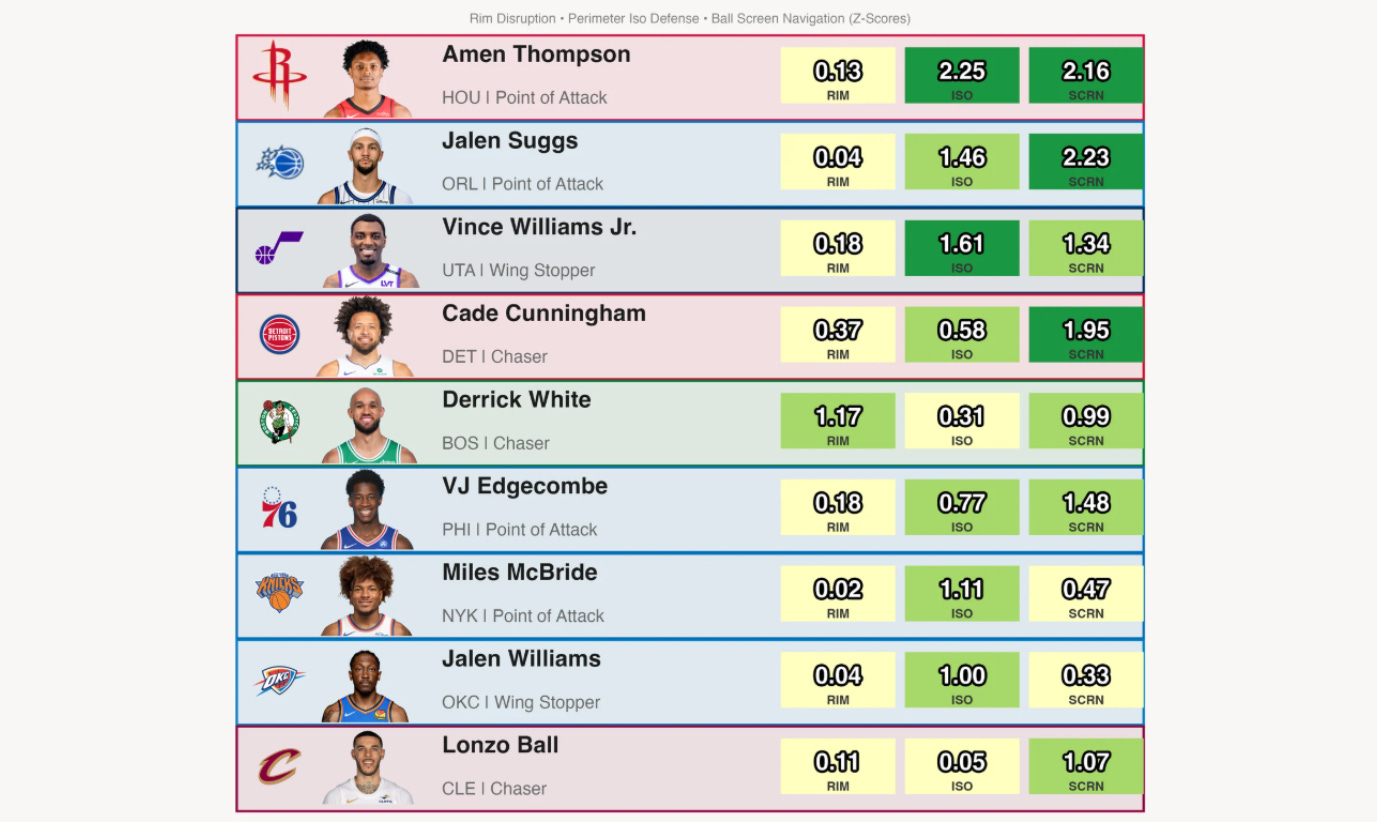
McBride has a unique intersection of defensive skills, he can disrupt the rim at an average level among off/on-ball guards, while also showcasing strong point-of-attack play. He ranks as one of five guards to post both an above-average mark and a z-score above one in rim disruption and perimeter isolation defense, respectively. He’s a true athlete, boasting a great vertical and a long wingspan among his peers. His versatility makes him a valuable asset across multiple schemes and opponents, despite his lack of height.
When filtered among on/off-ball wings we’d find a more wider group capable of protecting the rim, and keeping up with handlers at a high level, including Alex Caruso, OG Anunoby, Lu Dort etc.
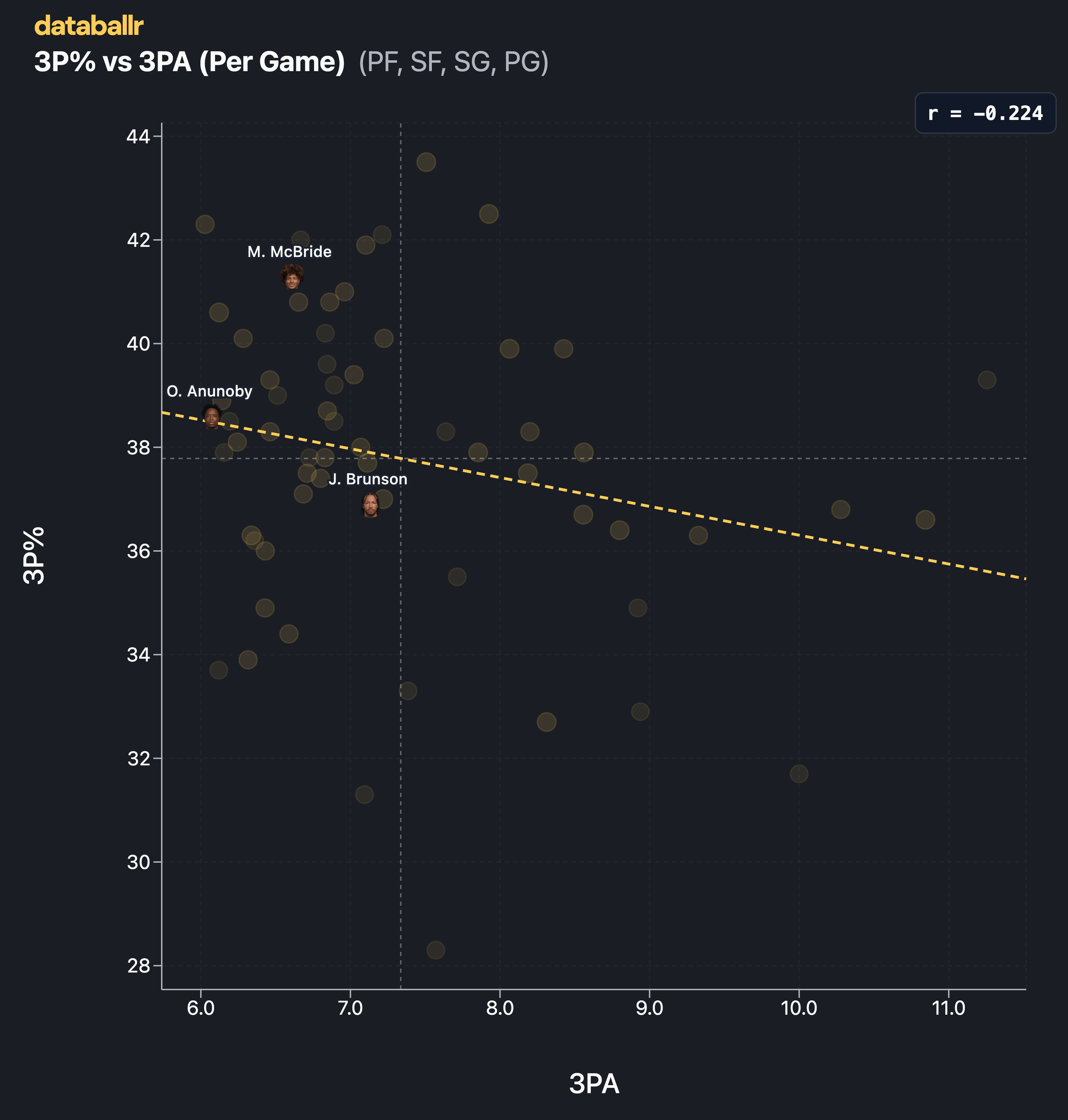
Few players shoot it like McBride. His shooting value goes beyond the normal spacer, standing out above wings and guards alike. What matters most, though, is the impact his shooting talent has on the roster.
His superior shooting skill outpaces every other player on the team, driven by a combination of elite efficiency and high volume. He can shoot on the move, off the dribble, in handoff actions, and within heavily confined spaces; his perimeter production requires almost zero contextual dependence. Unlike his other high-impact traits, this specific skill is the most individualized and highly translatable year over year.

In terms of shooting consistency, during a long season, the Knicks missed McBride’s shotmaking at certain points.
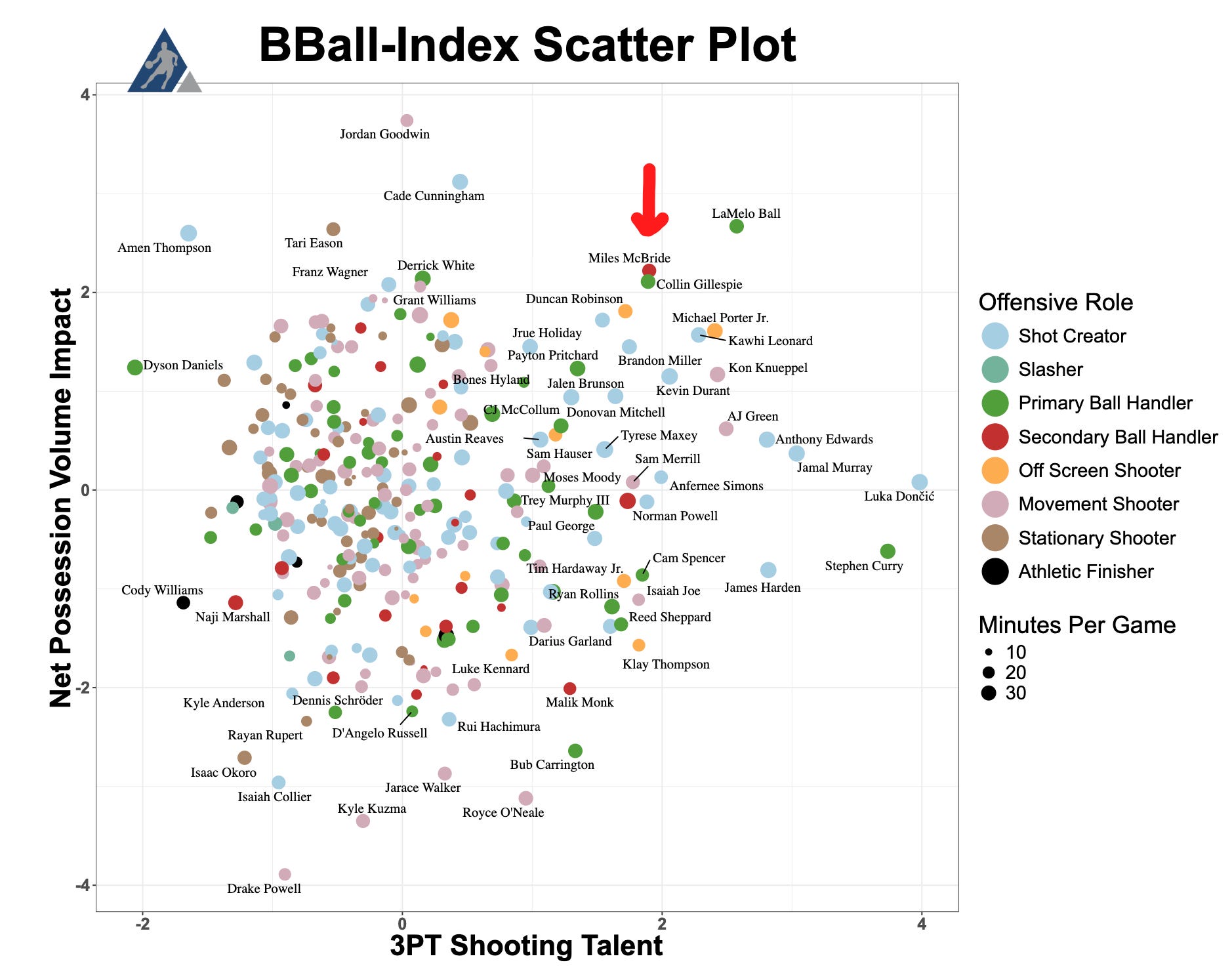
Net Possession Volume Impact: measures a player’s overall net influence on generating or preventing extra team possessions (through rebounding and limiting turnovers) relative to league average, adjusted for teammates and opponents
McBride offers premium role player talent at a very low price. Even though some immediately think trade, given his expiring contract, teams must retain such high-value players during a championship window. Players like McBride don’t grow on trees. We don’t need to filter for guards to find him among the league’s best in three-point shooting talent and possession-maxing ability. Two variables that have contributed to winning basketball and explain his positive team impact over the years.
The idea that the Knicks need to acquire another wing, or that McBride's skillset is easily replicable, holds little weight. How many wings have his skillset and can mirror McBride's team impact? I believe very few can. His contract situation shouldn't deter the Knicks from holding onto him, and his shorter stature shouldn't override who he is as a player. I'm sure the league, and especially New York's fans, can attest to that by now..
wings are like the snake oil of the NBA. because legends and superstars happened to be wings and it’s the most coveted archetype/position in the league, it’s led people to think that because you have the physical tools of a wing, you will always contribute in a theoretical way. assuming defensive versatility, transition scoring, things that aren’t bound by self creation and expecting most wings to be able to do it/develop it. there’s been a lot of fluid wings who don’t contribute much in any area despite having size and some amount of skill. the ancillary skills matter more because they can be used in any context
Deuce Mcbride is one of our best poa defenders and of course a high volume 3 point shooter, hope we keep him and see if we can give him an extension that makes both sides happen!